It is 3:00 PM, and your eyes feel heavy. Your attention is drifting, and you find yourself squinting at your screen. You think you need more coffee, but the real problem might be simpler: your desk is not bright enough.
Before we dive in, let us clarify two essential terms that are often confused:
- Lumens: The total amount of light emitted by a bulb. This measures the output of the light source itself.
- Lux: The amount of light that actually reaches a surface. This is what truly matters for your work desk.
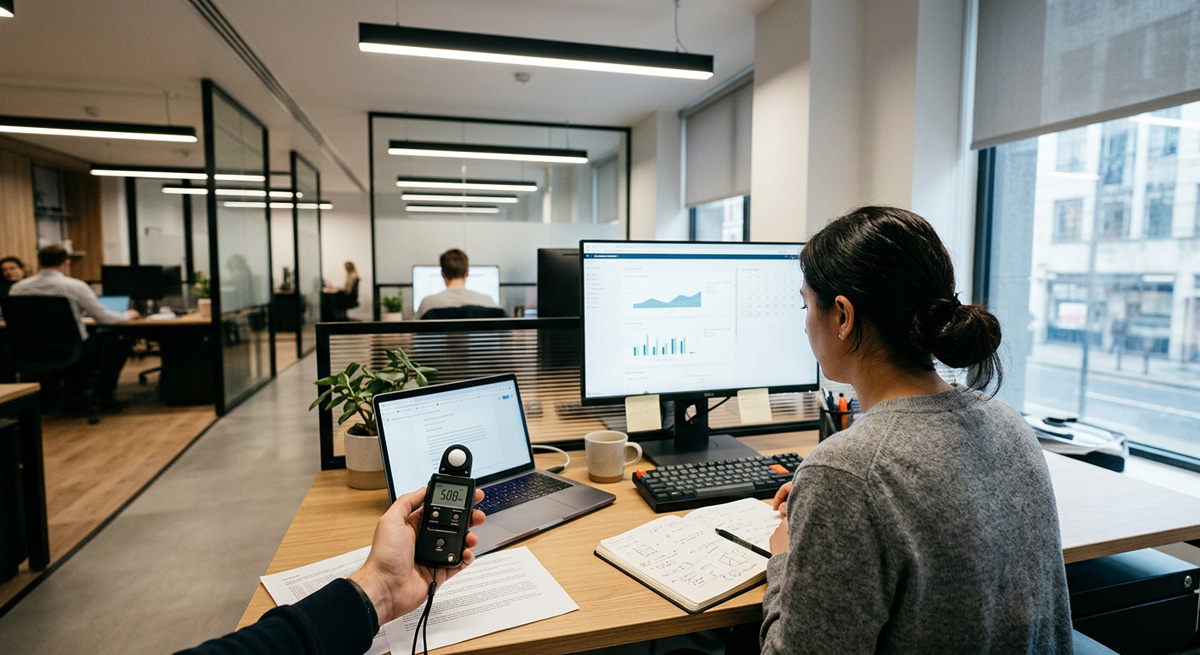
As a professional lighting consultant, Guocio is here to tell you the answer: the international standard for a properly lit office desk is **500 lux**. In this guide, we will explore how to achieve this benchmark through expert Office lighting design.
The Industry Standard: 500 Lux for Office Desks
According to the European standard EN 12464-1 and recommendations from the Illuminating Engineering Society (IES) in North America, the recommended illuminance for standard office tasks—such as reading, writing, and computer work—is 500 lux.
What does 500 lux feel like? Imagine an overcast day outdoors or a well-lit library reading room. It is bright enough to see fine text clearly, yet comfortable enough to prevent eye strain.
Understanding the extremes is crucial for any Commercial Lighting Solutions project:
- Too Little (<300 lux): Leads to eye fatigue, headaches, and increased error rates.
- Too Much (>750 lux): Creates uncomfortable glare, especially when combined with computer screen work.
How to Achieve 500 Lux: The Two-Layer Strategy
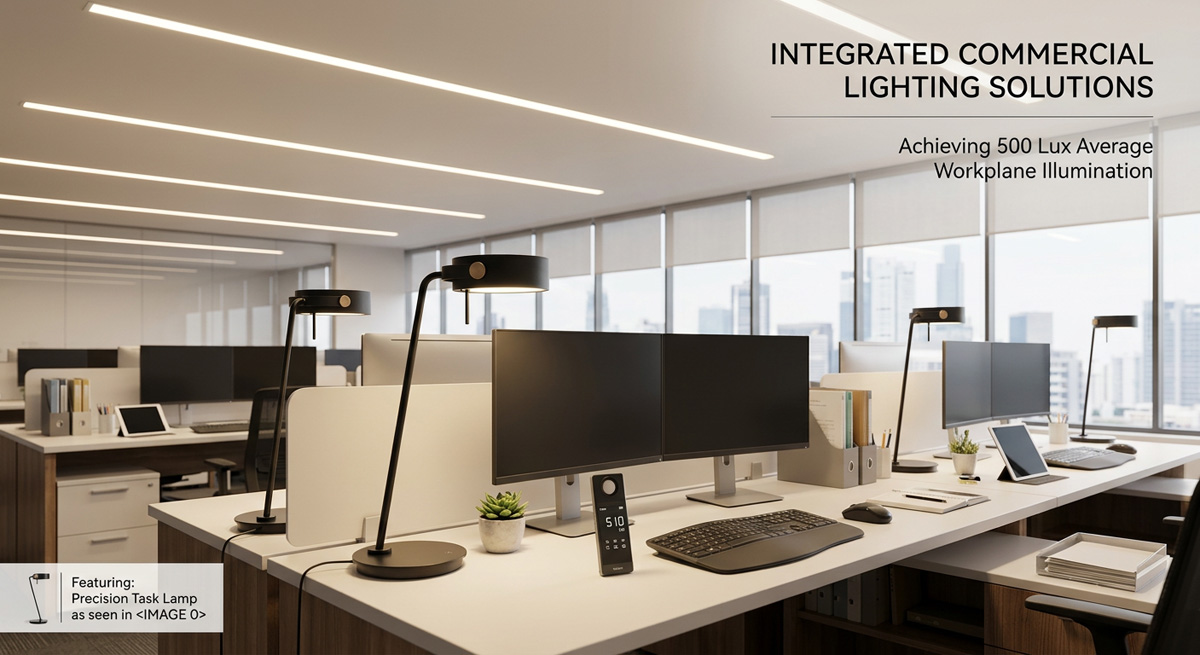
Premium Office lighting Solutions never rely on a single light source. The key to achieving a consistent 500 lux across every workstation is the two-layer strategy:
Layer 1: Ambient Lighting (Approx. 300-400 lux). Install anti-glare Ceiling Lamps or stylish suspended Pendant Lamps to provide a uniform base level of brightness across the entire office floor.
Layer 2: Task Lighting (Supplementing an additional 200-300 lux). Equip each desk with a high-quality, adjustable Table Lamp. This not only brings the desk surface precisely to the 500 lux target but also empowers employees to personalize their lighting—a critical factor for satisfaction and productivity.
Lumens vs. Lux: How to Choose the Right Bulb
If lumens measure output and lux measures illuminance on a surface, how do you pick the right bulb for your desk lamp? The simple formula is:
Lux = Lumens ÷ Area (m²)
Practical Example: A standard office desk is approximately 1.2m x 0.8m, which equals roughly 1 square meter. To achieve 500 lux on this surface with a desk lamp positioned about 40cm above, you will typically need a bulb outputting approximately 500-700 lumens (accounting for light diffusion and distance decay).
Guocio’s premium Table Lamp series comes with precisely calibrated lumen outputs and dimmable functionality, making it effortless to hit the 500 lux target.
Special Zones: Not All Desks Are Equal
Different tasks require different illumination levels:
- Detailed Design Work (750 lux): Tasks like reviewing architectural blueprints or inspecting circuit boards demand higher brightness. Add a focused Spot Light for localized enhancement.
- Reception Desks (300-400 lux): These do not require intense brightness, but the light must be flattering on faces. A soft Wall Lamp or warm-toned pendant creates a welcoming atmosphere.
The WFH Challenge: Measuring Brightness at Home
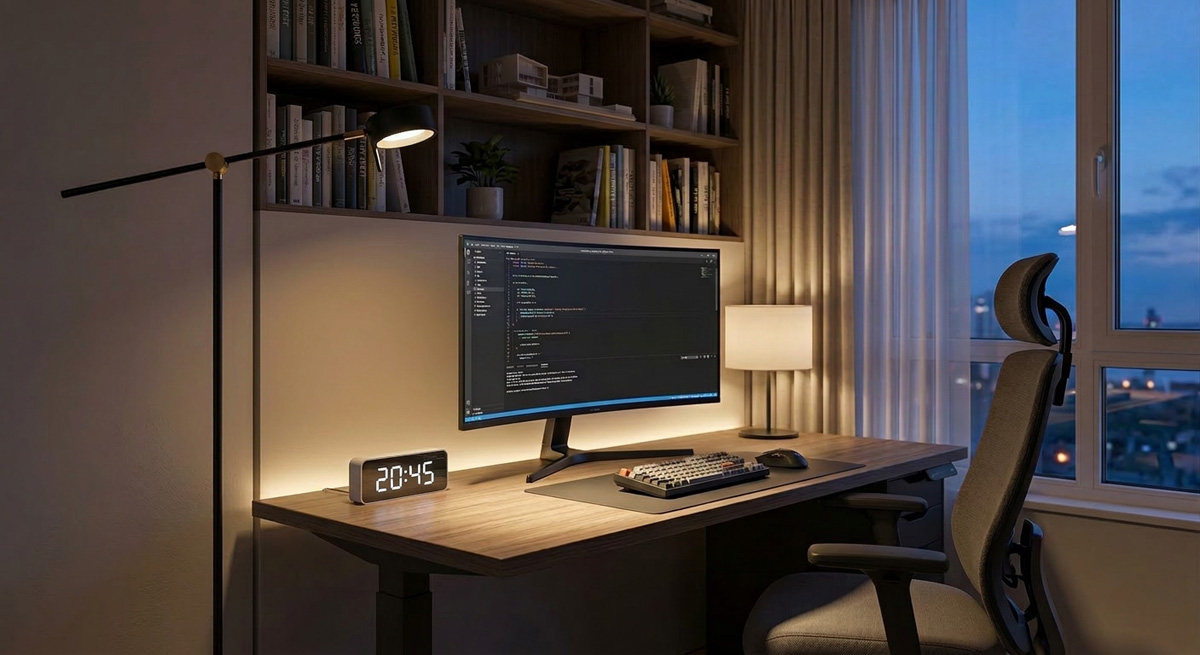
When working from home, your Home lighting design often lacks professional planning. Most residential spaces fall far short of 500 lux at the desk!
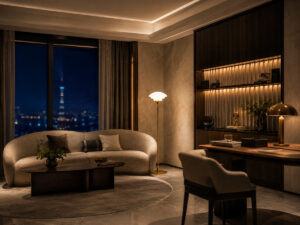
- The Living Room (Typically only 100-150 lux): If you are working on a laptop on the sofa, the ceiling chandelier provides woefully inadequate light. Excellent living room lighting design requires adding an adjustable Floor Lamp directed at your keyboard, creating a functional living roomlighting Solutions for work.
- The Kitchen Island (Typically 300-400 lux): The Pendant Lamp over the island is usually designed for cooking, not paperwork. Upgrade your kitchen lighting design with a higher-lumen, dimmable fixture to ensure complete kitchen lighting Solutions.
- The Bedroom (Typically only 50-100 lux): Reviewing documents in bed is a disaster for your eyes. Proper bedroom lighting design demands a dedicated reading Wall Lamp or a focused Spot Light beside your pillow to deliver eye-safe bedroom lighting Solutions.
Illuminate Your Workspace with Guocio
500 lux is not an arbitrary number; it is an international standard based on visual science. Achieving it requires a strategic combination of ambient and task lighting.
Unsure if your office or home workspace meets the standard? Contact Guocio today to book professional lighting design services. We offer lux measurement consultations and will craft bespoke Commercial Lighting Solutions tailored to your exact needs. Brighten your day the right way!