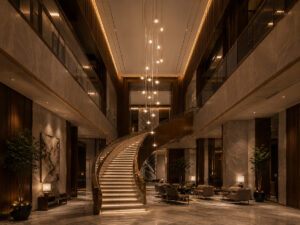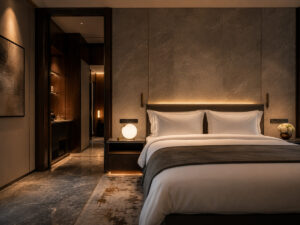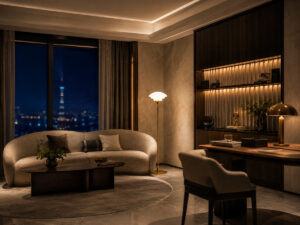
Energy costs are rising. Sustainability regulations are tightening. And clients — whether they are developers, hospitality brands, or corporate occupiers — are demanding spaces that are both beautifully lit and responsibly designed. In this environment, energy-efficient lighting design is no longer a nice-to-have. It is a business imperative.
Yet many projects still approach lighting as an afterthought — selected from a catalogue, installed without a coherent strategy, and optimised for neither aesthetics nor efficiency. The result? Spaces that consume more energy than necessary, carry higher long-term operational costs, and fail to deliver the visual experience that owners and occupants deserve.
This guide is written for developers, architects, interior designers, and project procurement teams who want to get lighting design right from the start. We will walk you through the principles, the process, the fixture comparisons, and the professional insights you need to design a lighting system that performs beautifully — and efficiently — for years to come.
1. What Is Energy-Efficient Lighting Design?
Definition and Core Principles
Energy-efficient lighting design is the strategic process of planning, selecting, and controlling light sources and fixtures to achieve the desired visual environment while minimising energy consumption and operational costs. It is not simply about replacing old bulbs with LEDs. It is a holistic discipline that considers the type of light source, the layout of fixtures, the control systems employed, and the way natural light interacts with artificial illumination throughout the day.
The core principles of energy-efficient lighting design include:
- Right light, right place, right time — delivering the appropriate intensity and colour of light precisely where and when it is needed, and nowhere else.
- Layered lighting strategy — combining ambient, task, and accent lighting to create flexible, efficient illumination that can be adjusted for different uses and times of day.
- Technology integration — using LED light sources, smart controls, occupancy sensors, and daylight harvesting systems to reduce energy waste automatically.
- Long-term performance thinking — selecting fixtures and systems based on total cost of ownership, not just upfront purchase price.
Why It Matters for Commercial Projects
Lighting typically accounts for 20% to 40% of a commercial building’s total electricity consumption. For hotels, offices, retail environments, and mixed-use developments, this represents a substantial and highly manageable operating cost. A professionally designed energy-efficient lighting system can reduce this consumption by 50% or more — generating meaningful savings over the life of a building.
Beyond cost savings, energy-efficient lighting design contributes to green building certifications such as LEED and BREEAM, supports corporate ESG commitments, and creates healthier, more productive environments for occupants. It also future-proofs your project against tightening energy codes and regulations that are increasingly mandating minimum efficiency standards for new construction and major renovations.
At Guocio, our lighting design services are built around this integrated, performance-first philosophy — ensuring every project we work on delivers both exceptional visual quality and measurable energy performance.
2. Key Factors That Affect Lighting Energy Efficiency
Understanding the levers that drive energy efficiency in lighting design is essential for making informed decisions at every stage of a project. There are four primary factors that every project team should consider.
Light Source Selection
The choice of light source is the single most impactful decision in energy-efficient lighting design. Modern LED (Light-Emitting Diode) technology has transformed the industry, offering luminous efficacy levels — measured in lumens per watt — that are four to five times higher than traditional incandescent sources and significantly better than older fluorescent systems.
When selecting light sources, key performance metrics to evaluate include:
- Luminous Efficacy (lm/W) — how much visible light is produced per watt of electricity consumed. High-quality LEDs now achieve 130–200 lm/W.
- Colour Rendering Index (CRI) — how accurately the light source renders colours. A CRI of 90+ is recommended for hospitality, retail, and residential environments.
- Colour Temperature (CCT) — measured in Kelvin, this determines whether light appears warm (2700K–3000K), neutral (3500K–4000K), or cool (5000K–6500K). Selecting the appropriate CCT for each space type is critical to both user comfort and energy performance.
- Rated Life (hours) — directly impacts maintenance frequency and long-term operational costs. Premium LED sources are rated for 50,000 hours or more.
Lighting Controls and Automation
Even the most energy-efficient light source wastes energy if it is left on unnecessarily. Lighting control systems are the multiplier that transforms a good lighting design into a genuinely efficient one. Key control strategies include:
- Occupancy and vacancy sensors — automatically switch lights on when spaces are occupied and off when they are empty. Highly effective in meeting rooms, corridors, restrooms, and storage areas.
- Daylight harvesting — photosensors measure available natural light and automatically dim or switch off artificial lighting to maintain a consistent illumination level, reducing energy use during daylit hours.
- Dimming systems — allow light levels to be reduced in response to occupancy, time of day, or specific scene requirements. Even dimming to 70% output reduces energy consumption by approximately 30%.
- Time scheduling — programmed on/off and dimming schedules aligned with operational hours ensure lighting is never running at full power when not required.
- Building Management System (BMS) integration — for larger commercial developments, integrating lighting controls into a centralised BMS enables facility managers to monitor and optimise lighting energy use across the entire building in real time.
Spatial Layout and Lighting Zones
The physical arrangement of fixtures within a space has a profound effect on energy efficiency. A poorly laid-out lighting scheme may require more fixtures — and more watts — to achieve the desired illumination levels, while a well-designed layout achieves the same result with fewer, better-positioned luminaires.
Effective zoning divides a space into distinct areas with independent controls, allowing each zone to be managed according to its specific use pattern. In a commercial office, for example, perimeter zones adjacent to windows can be independently dimmed based on daylight levels, while interior zones with no access to natural light maintain a consistent output. This simple zoning strategy alone can deliver energy savings of 15% to 25% compared to a uniformly controlled space.
Natural Light Integration
The most energy-efficient light source is the sun. A high-performance lighting design acknowledges this and actively plans for the integration of natural daylight into the illumination strategy. This involves working with architects during the early design stages to maximise window placement, glazing performance, and the use of light-reflective interior finishes — all of which reduce the dependency on artificial light during daytime hours.
Spaces that successfully integrate natural and artificial light create environments that are not only more energy-efficient but also more comfortable and conducive to wellbeing — a benefit that is increasingly recognised in workplace design research and hospitality design standards.
3. Energy-Efficient Lighting Design by Space Type
Different spaces have different lighting requirements, user behaviours, and energy-saving opportunities. Here is how energy-efficient lighting design principles apply across the most common project types.
Office Lighting Design
The office environment is one of the highest-impact areas for lighting energy optimisation. Standard office spaces require consistent, glare-free illumination that supports visual tasks without causing fatigue — typically in the range of 300 to 500 lux at the working plane.
An energy-efficient office lighting design strategy should incorporate:
- High-efficacy LED ceiling lamps or recessed panels as the primary ambient layer.
- Task lighting at individual workstations to supplement ambient levels and allow personal adjustment — reducing the need to illuminate entire floors uniformly.
- Perimeter daylight harvesting zones controlled independently from interior zones.
- Occupancy sensors in all meeting rooms, breakout spaces, and support areas where usage is intermittent.
- Spot lights used selectively for accent and feature lighting in reception and collaboration areas, kept on separate circuits for independent control.
When designed and implemented correctly, an energy-efficient office lighting system can achieve a Lighting Power Density (LPD) well below the 10 W/m² benchmark that many energy codes now require as a minimum standard.
Living Room Lighting Design
For residential developers and hospitality projects, the living room represents both a design centrepiece and a significant opportunity for energy efficiency. Living room lighting must serve multiple functions — general illumination, task lighting for reading and working, and accent lighting for artwork and architectural features — while remaining flexible enough to create different moods at different times.
An energy-efficient living room lighting design typically features:
- A statement pendant lamp or ceiling lamp as the primary ambient source, selected for high CRI and warm CCT (2700K–3000K).
- Floor lamps and table lamps providing layered, dimmable accent and task lighting.
- Wall lamps offering directional light for artwork display or architectural highlighting.
- All circuits on dimmer controls, enabling significant energy reduction during lower-activity periods.
- Smart scene presets that allow occupants to select pre-programmed lighting scenes optimised for different activities, each designed to use the minimum energy required.
Kitchen Lighting Design
The kitchen demands precise, functional illumination for food preparation tasks alongside ambient lighting for dining and socialising. It is also one of the spaces where overlighting is most common — a costly and unnecessary mistake in both residential and commercial kitchen environments.
Energy-efficient kitchen lighting design incorporates high-efficacy LED sources in both the ambient and task layers, with spot lights or under-cabinet task lights focused precisely on work surfaces. Independent zoning allows task lighting to be used alone when the kitchen is in active use, while ambient levels are kept low — significantly reducing overall consumption compared to a single-circuit, uniformly bright kitchen.
Bedroom Lighting Design
The bedroom is a space defined by transitions — from bright, alert wakefulness to relaxed, dim evening conditions. An energy-efficient bedroom lighting design accounts for these transitions by creating a fully dimmable, layered system that delivers the right light for each moment while consuming only the energy that each situation genuinely requires.
Key fixtures in an energy-efficient bedroom design include dimmable ceiling lamps or recessed downlights for general illumination, wall lamps at the bedside for reading, and table lamps that add warmth and personality. For hospitality projects, smart controls that integrate with room management systems allow lights to power down automatically when guests leave the room — a simple measure that dramatically reduces energy waste in hotel operations.
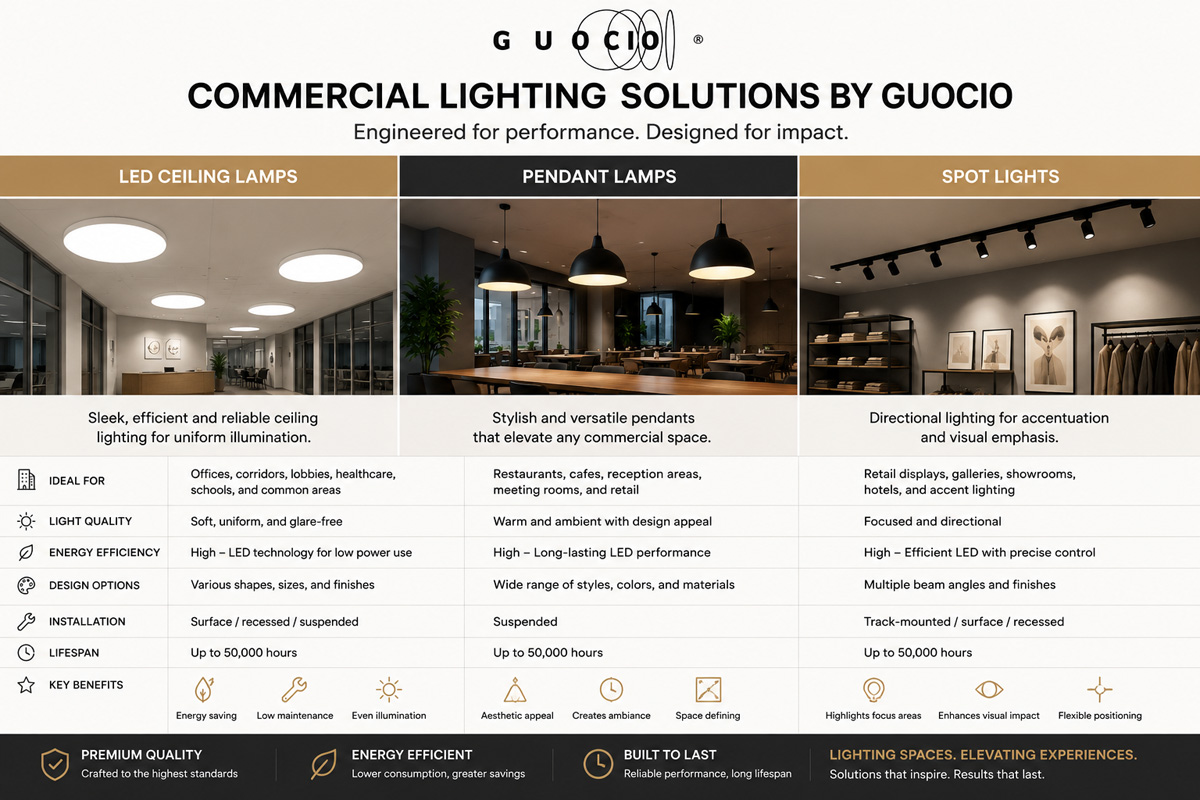
4. Energy-Efficient Lighting Options Compared: Which Is Right for Your Project?
One of the most common questions project teams face is how to evaluate and compare different lighting technologies and fixture types. The table below provides a clear, objective comparison of the four primary lighting options encountered in commercial and high-end residential projects — helping you make an informed decision based on your project’s priorities, budget, and performance requirements.
| Comparison Criteria | 💡 LED Lighting | 🔆 Halogen | 🔵 Fluorescent | 🤖 Smart Lighting System |
|---|---|---|---|---|
| Energy Consumption | ✅ Lowest (130–200 lm/W) | ❌ Highest (15–25 lm/W) | ⚠️ Moderate (60–100 lm/W) | ✅ Optimised via automation |
| Rated Lifespan | ✅ 25,000–50,000 hrs | ❌ 2,000–4,000 hrs | ⚠️ 8,000–15,000 hrs | ✅ Extends fixture lifespan via dimming |
| Upfront Cost | ⚠️ Moderate | ✅ Low | ✅ Low to Moderate | ❌ Higher (infrastructure investment) |
| Long-Term ROI | ✅ Excellent | ❌ Poor | ⚠️ Fair | ✅ Best overall |
| Design Flexibility | ✅ High — wide fixture range | ⚠️ Moderate — warm, decorative | ❌ Low — limited aesthetics | ✅ Maximum — programmable scenes |
| Dimmability | ✅ Yes (with compatible dimmer) | ✅ Yes | ⚠️ Limited / requires special ballast | ✅ Full automated dimming |
| Environmental Impact | ✅ Low — no mercury | ❌ High carbon footprint | ⚠️ Contains mercury — disposal issues | ✅ Lowest operational carbon |
| Best Suited For | All space types — universal application | Decorative accent use only | Legacy retrofits — being phased out | High-end commercial, hospitality, premium residential |
| Guocio Recommendation | ✅ Primary recommended source | ❌ Not recommended for new projects | ❌ Avoid in new builds | ✅ Strongly recommended for commercial |
✅ Best Performance | ⚠️ Moderate / Conditional | ❌ Not Recommended for Energy-Efficient Projects
The data is clear: for the vast majority of new commercial and high-end residential projects, LED lighting combined with smart control systems delivers the optimal balance of energy efficiency, design quality, longevity, and long-term return on investment. Halogen and standard fluorescent sources should be avoided in new-build specifications and considered only in legacy retrofit situations where immediate full replacement is not feasible.
5. Step-by-Step: How to Design Energy-Efficient Lighting for Your Project
A structured, methodical approach to lighting design is what separates a genuinely energy-efficient system from one that is merely fitted with LED bulbs. Here is the professional process that Guocio follows on every project.
Step 1 — Conduct a Lighting Audit
Before any design work begins, the existing lighting situation (for retrofit projects) or the project brief and architectural drawings (for new builds) must be thoroughly analysed. A lighting audit identifies current energy consumption, existing fixture types and conditions, occupant complaints or inadequacies, and the opportunities available for improvement.
For new build projects, the audit phase involves reviewing floor plans, reflected ceiling plans, glazing schedules, and interior finish specifications to understand the baseline conditions that the lighting design must address. This analysis informs every subsequent design decision and ensures that the finished system is calibrated precisely for the space it serves.
Step 2 — Define Lighting Zones and Layers
Once the spatial context is understood, the next step is to define the lighting zones and establish the layered lighting strategy for each zone. This involves determining:
- Which areas will be independently controlled (zoning)
- What activities will take place in each zone and what illumination levels are required (task analysis)
- How ambient, task, and accent layers will be combined in each space to achieve both functionality and visual quality
- Where natural light is available and how it will be integrated with artificial lighting through sensor-based controls
This step is where the creative and technical dimensions of lighting design intersect — and where the expertise of a professional lighting design service delivers the greatest value.
Step 3 — Select the Right Fixtures
Fixture selection must balance three considerations: optical performance (how the fixture delivers light into the space), aesthetic quality (how the fixture contributes to the interior design concept), and energy efficiency (how much energy the fixture consumes relative to the light it produces).
At Guocio, our curated collection of luminaires spans every category required for a complete, high-performance lighting design:
- Ceiling Lamps — for primary ambient illumination in living areas, offices, and hospitality spaces.
- Pendant Lamps — for statement lighting over dining tables, reception desks, and feature areas.
- Spot Lights — for precise task and accent illumination, artwork highlighting, and retail merchandise display.
- Wall Lamps — for layered ambient and accent lighting in corridors, bedrooms, and feature walls.
- Floor Lamps — for flexible, moveable accent and task lighting in living areas and hospitality suites.
- Table Lamps — for intimate, layered accent lighting on surfaces and bedside applications.
- Art Mirrors — for integrated lighting and decorative impact in bathrooms, dressing areas, and feature walls.
Every fixture in our range is selected for LED compatibility, dimmability, and long-term performance reliability — ensuring that your fixture specification aligns perfectly with your energy efficiency objectives.
Step 4 — Integrate Smart Controls
The fixture specification must be developed in parallel with the control strategy. Smart lighting controls are the mechanism by which a well-designed system achieves its energy performance targets in real-world operation. At minimum, an energy-efficient commercial lighting system should incorporate:
- DALI or 0-10V dimming protocol for all dimmable circuits
- Occupancy/vacancy sensors in intermittently used areas
- Daylight sensors in perimeter zones adjacent to glazing
- Scene controllers or time-based scheduling for areas with predictable use patterns
For larger developments, integration with a centralised BMS or dedicated lighting management platform enables energy monitoring, remote management, and data-driven optimisation over the life of the building.
Step 5 — Work with a Professional Lighting Consultant
The steps above describe a complex, multi-disciplinary design process that requires specialist knowledge in photometrics, electrical engineering, interior design, and building services coordination. Attempting to navigate this process without professional expertise typically results in costly errors — over-specified systems, non-compliant designs, or disappointing visual outcomes that require expensive remediation after construction is complete.
A professional lighting consultant manages the entire process — from initial audit and concept design through to fixture specification, control system design, installation coordination, and commissioning — ensuring that the finished system performs exactly as designed, from day one.
6. Common Mistakes to Avoid in Energy-Efficient Lighting Design
Even well-intentioned energy-efficient lighting projects can fall short of their potential if these common mistakes are not actively avoided.
Mistake 1 — Overlighting
More light does not mean better light. Over-specified illumination levels not only waste energy directly but also create uncomfortable glare, visual fatigue, and an environment that feels clinical rather than inviting. The correct approach is to specify illumination levels based on the specific visual tasks to be performed in each area — and to use layering and dimming to modulate those levels dynamically throughout the day.
Mistake 2 — Ignoring Maintenance Costs
The upfront purchase price of a lighting fixture is only one component of its true cost. Fixtures with short-rated lives, difficult re-lamping requirements, or fragile construction generate significant maintenance costs over time — costs that quickly erode any initial savings made by choosing lower-quality products. Premium LED fixtures with 50,000-hour rated lives and tool-free maintenance access deliver dramatically lower lifecycle costs, even when their upfront price is higher.
Mistake 3 — Treating Lighting as a Single Circuit
Installing all lights on a single circuit with a single switch is the most fundamental energy management mistake possible. Without independent zone control, every lamp in a space must be on or off together — making it impossible to implement any of the energy-saving strategies described in this guide. Independent zoning is non-negotiable in any project that takes energy efficiency seriously.
Mistake 4 — Neglecting Natural Light
Designing artificial lighting without accounting for the contribution of natural daylight leads to systems that run at full power during daylit hours when significant energy savings are available. Daylight harvesting — even in its simplest form — can reduce lighting energy consumption by 20% to 30% in spaces with good glazing exposure, at minimal additional cost.
Mistake 5 — Delaying Lighting Design to Late-Stage Construction
Lighting design is most effective — and most cost-efficient — when integrated into a project from the earliest design stages. Late-stage lighting decisions are constrained by decisions already made about ceiling heights, structure, MEP routing, and interior finishes — and any changes required to optimise the lighting design at this stage come at a significant premium. Engaging a professional lighting design service at concept stage is always the most economical and effective approach.
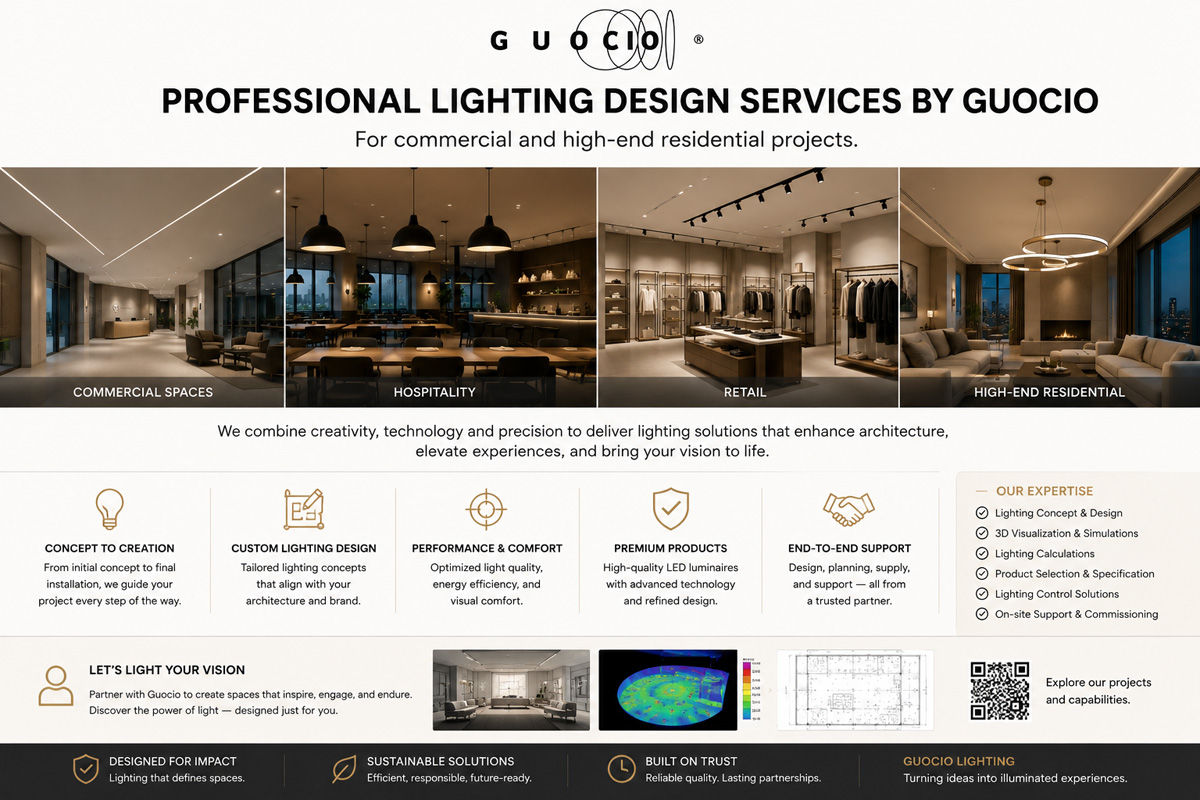
7. Why Work with Guocio for Your Energy-Efficient Lighting Design?
At Guocio, we understand that exceptional lighting is both a science and an art. Our team combines deep technical expertise in photometrics, energy performance, and control systems with a refined design sensibility that has been applied across commercial developments, hospitality projects, corporate offices, and premium residential builds.
When you work with Guocio, you benefit from:
- Integrated design and supply — we manage both the design process and the fixture supply chain, ensuring perfect alignment between specification and product and eliminating the coordination gaps that cause delays and cost overruns in many projects.
- A curated, performance-verified product range — every fixture we specify is selected for LED efficiency, dimmability, long-term reliability, and aesthetic quality. We do not compromise on product standards because we understand that product quality is the foundation of long-term system performance.
- Energy performance commitment — our designs are developed with measurable energy targets from the outset, and we provide the calculations and documentation required to support green building certification applications.
- End-to-end project support — from initial consultation and concept design through to installation coordination, commissioning, and aftercare, we remain engaged throughout the project lifecycle to ensure the finished result matches the design intent.
- B2B partnership approach — we work as a committed partner to architects, interior designers, developers, and project management teams — providing the technical expertise and reliable supply chain that professional project teams depend on.
Whether you are developing a commercial office campus, a boutique hotel, a luxury residential tower, or a mixed-use retail and hospitality destination, Guocio has the expertise, the products, and the commitment to deliver an energy-efficient lighting design that performs — beautifully and sustainably — for the life of your building.
Ready to Design a Smarter, More Efficient Lighting System?
Talk to Guocio’s expert lighting consultants today. We will help you define the right strategy, select the right fixtures, and deliver an energy-efficient lighting design that exceeds your performance and aesthetic goals.
Get a Free Consultation →
Explore our full range of lighting design services or browse our product collections.
Frequently Asked Questions About Energy-Efficient Lighting Design
What is the most energy-efficient type of lighting?
LED lighting is currently the most energy-efficient type of lighting available. LEDs consume up to 80% less energy than traditional incandescent bulbs and last up to 25 times longer, making them the preferred choice for both commercial and residential lighting design projects. When combined with smart control systems, LED lighting delivers the highest possible level of energy performance.
How much can energy-efficient lighting reduce electricity costs?
Switching to energy-efficient lighting, particularly LED systems combined with smart controls, can reduce a building’s lighting energy consumption by 50% to 75%. For large commercial projects — offices, hotels, retail developments — this translates to substantial annual savings in operational costs, often delivering full return on investment within two to four years of installation.
What lighting fixtures are best for commercial energy efficiency?
For commercial projects, high-efficacy LED ceiling lamps, recessed spot lights, and dimmable pendant lamps are among the most effective choices. When these fixtures are paired with occupancy sensors and daylight harvesting controls, they deliver maximum energy performance without compromising on light quality or visual comfort.
How does smart lighting improve energy efficiency?
Smart lighting systems use sensors, timers, and automated controls to ensure lights operate only when and where needed. Features including occupancy detection, daylight-responsive dimming, and centralised remote management can reduce lighting energy waste by up to 40% compared to manually controlled systems. For large commercial buildings, smart lighting also provides real-time energy monitoring data that enables ongoing operational optimisation.
Do I need a lighting consultant for an energy-efficient lighting project?
For commercial developments, hospitality projects, and large residential builds, working with a professional lighting consultant is strongly recommended. A lighting consultant ensures your design meets current energy codes and standards, maximises long-term ROI, and delivers the visual quality that your project demands — while avoiding the costly specification errors and remediation work that frequently arise from unguided lighting decisions.
How long does it take to design an energy-efficient lighting system?
The timeline depends on project scale and complexity. A standard commercial office project typically requires two to four weeks for design development and fixture specification. Larger developments — hotels, mixed-use buildings, or campus projects — may require six to twelve weeks, including coordination with architects, interior designers, and MEP engineers. Engaging your lighting design team as early as possible in the project programme is the best way to ensure the design process does not become a critical path constraint.