
A Complete Timeline Guide: When to Bring in Professional Lighting Design for Maximum Impact
Sarah had just finished a stunning $150,000 kitchen renovation. New custom cabinets, marble countertops, professional-grade appliances—everything was exactly as she’d dreamed. But when evening came and she turned on the lights, her heart sank. Harsh shadows fell across her beautiful countertops. The pendant lights she’d picked created glare that made the space feel uncomfortable. Her gorgeous backsplash looked flat and lifeless.
“I spent so much time choosing finishes and fixtures,” she told us when she called. “Why didn’t anyone tell me I needed to think about lighting earlier?”
This story—or some version of it—is the most common call we receive. And it always starts with the same question: “When should I have hired a lighting designer?”
The answer is simple, though not always what people want to hear: Earlier than you think.
In lighting design, timing isn’t just important—it’s everything. Hire too late, and you’re limited by decisions already made. Hire at the right moment, and you unlock possibilities that simply don’t exist later in the project.
This comprehensive guide will walk you through exactly when to bring in a lighting designer, what happens at each stage of your project, and why understanding this timeline could save you thousands of dollars and years of regret.
Why the Timing of Hiring a Lighting Designer Matters
Before diving into specific timelines, let’s understand why timing is so critical in lighting design—more so than almost any other design discipline.
The Advantages of Early Involvement
When a lighting designer joins your project early, the benefits compound:
- Seamless integration – Lighting becomes part of the architecture, not an afterthought
- Maximum flexibility – All options remain open for fixture placement, control zones, and design approaches
- Lowest cost – Changes on paper cost virtually nothing; changes during construction cost significantly more
- Natural light optimization – Window placement and shading can be influenced to work with artificial lighting
- Ceiling design coordination – Soffits, coves, and architectural details can incorporate lighting from the start
- Adequate procurement time – Custom or long-lead fixtures can be ordered without rushing
The Limitations of Late Involvement
When a lighting designer joins late, every conversation starts with constraints:
- Fixed electrical rough-in – Junction boxes and circuits are already in place
- Committed ceiling structure – No room for recessed fixtures or architectural lighting details
- Limited fixture choices – Must work with existing electrical locations
- Compressed timeline – Rush decisions lead to compromises
- Higher costs – Change orders, rewiring, and demolition add expense
- Diminished results – Working around limitations rather than creating ideal solutions
The Numbers Tell the Story
Based on our project experience, the data is clear:
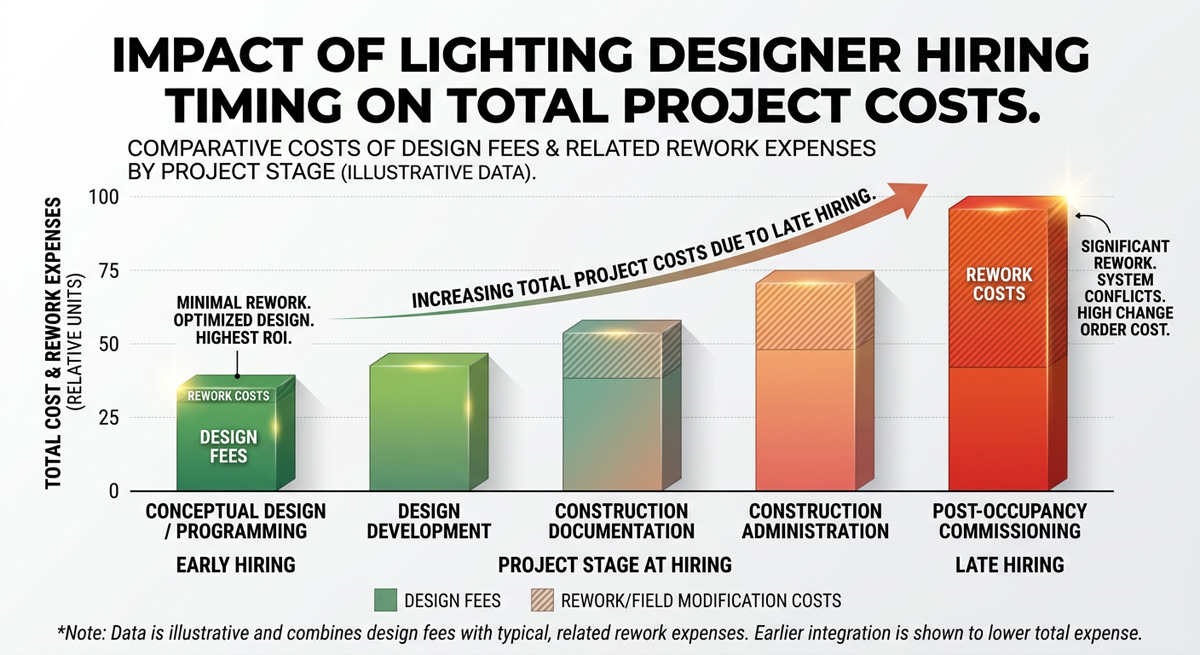
| When You Hire | Design Flexibility | Cost Efficiency | Expected Results |
|---|---|---|---|
| Concept Stage | ⭐⭐⭐⭐⭐ | ⭐⭐⭐⭐⭐ | ⭐⭐⭐⭐⭐ |
| Design Development | ⭐⭐⭐⭐ | ⭐⭐⭐⭐ | ⭐⭐⭐⭐ |
| Construction Documents | ⭐⭐⭐ | ⭐⭐⭐ | ⭐⭐⭐ |
| During Construction | ⭐⭐ | ⭐⭐ | ⭐⭐⭐ |
| After Completion | ⭐ | ⭐ | ⭐⭐ |
The Complete Timeline: When to Bring in a Lighting Designer
Every project moves through distinct phases. Understanding where lighting design fits into each phase helps you make the right call at the right time.
Phase 1: Concept & Planning Stage ⭐⭐⭐⭐⭐
Project Progress: 0-15% | Rating: OPTIMAL
What’s Happening: You’ve decided to move forward with a project. You’re interviewing architects or designers, reviewing initial concepts, and dreams are taking shape on paper (or screen).
Why This is the Best Time:
- Floor plans are still flexible—lighting considerations can influence room layouts
- Window placement and sizes can be optimized for daylight and artificial lighting harmony
- Ceiling heights and architectural features can be designed to incorporate lighting
- Budget can be allocated appropriately from the start
- The lighting designer becomes a true member of the design team
What We Can Do at This Stage:
- Develop preliminary lighting concepts aligned with your vision
- Advise on spatial decisions that impact lighting (ceiling heights, window placement, room proportions)
- Establish realistic budget expectations
- Coordinate with your architect and interior designer from day one
Ideal Action: Schedule an initial consultation as soon as you’ve committed to the project, even before final floor plans.
Phase 2: Design Development Stage ⭐⭐⭐⭐
Project Progress: 15-40% | Rating: EXCELLENT
What’s Happening: Floor plans are established. Interior design is being developed. Materials and finishes are being selected. The project is becoming real.
Why This is Still Excellent Timing:
- Electrical layouts haven’t been finalized yet
- Ceiling designs can still incorporate lighting requirements
- There’s time to source the right fixtures, even custom or long-lead items
- Lighting can be designed to complement specific finishes and furniture selections
What We Can Do at This Stage:
- Create detailed lighting design plans
- Specify fixtures and control systems
- Develop control zone layouts and scene programming
- Coordinate with electrical engineer on circuit requirements
- Provide specifications for contractor pricing
Ideal Action: Engage a lighting designer as soon as interior design direction is established, before construction documents begin.
Phase 3: Construction Documentation Stage ⭐⭐⭐
Project Progress: 40-60% | Rating: GOOD (with caveats)
What’s Happening: Working drawings are being prepared. Contractors are bidding the project. Decisions are being locked in.
Challenges at This Stage:
- Some architectural decisions are already committed
- Changes may trigger redesign fees
- Timeline pressure increases
- Coordination becomes more complex
What’s Still Possible:
- Fixture selection and specification
- Control system design
- Switch and dimmer locations (if electrical drawings aren’t finalized)
- Fixture placement refinement within existing electrical rough-in
Ideal Action: Move quickly. Contact a lighting designer immediately and be prepared for accelerated decision-making.
Phase 4: During Construction ⭐⭐
Project Progress: 60-85% | Rating: LIMITED (but still valuable)
What’s Happening: Walls are going up (or coming down). Rough electrical is being installed. The project is physically taking shape.
Critical Window:
- Before ceilings are closed = last chance for recessed lighting changes
- Before drywall = opportunity to add or relocate junction boxes
- Before painting = final opportunity for easy modifications
What’s Still Achievable:
- Upgrading fixture selections from basic specifications
- Adding smart controls and automation
- Optimizing what’s already planned
- Ensuring proper installation and aiming
Realistic Expectations: You’re working within constraints. We focus on maximizing impact within existing conditions rather than ideal design.
Ideal Action: Call before ceilings close. Every week of delay eliminates options.
Phase 5: Post-Construction ⭐
Project Progress: 100% | Rating: CHALLENGING (but not hopeless)
What’s Happening: The project is complete. You’re living or working in the space. And the lighting isn’t what you’d hoped.
Available Solutions:
- Surface-mounted and track lighting systems
- Plug-in and portable lighting solutions
- Smart bulbs and retrofit controls
- Decorative fixtures that don’t require new wiring
- Targeted retrofits in specific areas (if willing to do minor construction)
Honest Assessment: We can significantly improve most spaces, but costs are higher and options more limited. Expectations must be realistic.
Ideal Action: Schedule a consultation to assess what’s possible. Many improvements may be simpler than you expect.
Optimal Timing by Project Type
Different projects have different rhythms. Here’s specific guidance based on what you’re planning:
🏠 New Home Construction
Best Time to Hire: During architectural design, alongside your architect
Recommended Lead Time: 3-6 months before construction begins
- Lighting can influence window placement and ceiling designs
- Full integration with MEP (mechanical, electrical, plumbing) coordination
- Maximum opportunity for architectural lighting features
- Coordination with landscape lighting from the start
🔨 Major Home Renovation
Best Time to Hire: When design direction is confirmed, before construction documents
Recommended Lead Time: 2-4 months before construction begins
- Assess existing electrical infrastructure
- Plan upgrades alongside renovation scope
- Coordinate with structural changes
- Integrate with whole-home systems if upgrading controls
🍳 Kitchen & Bathroom Remodel
Best Time to Hire: When cabinetry/layout is being selected
Recommended Lead Time: 4-8 weeks before construction begins
- Task lighting for countertops and work areas is critical
- Under-cabinet lighting requires early planning
- Mirror/vanity lighting needs coordination with fixture selection
- Shower/tub lighting has specific code requirements
🏢 Commercial & Retail Space
Best Time to Hire: As soon as lease is signed or space is acquired
Recommended Lead Time: 3-6 months before opening
- Lighting directly impacts customer experience and sales
- Must meet commercial codes and energy requirements
- Brand standards often dictate specific approaches
- Opening deadlines create hard constraints
💼 Office Space
Best Time to Hire: During space planning, with furniture layout
Recommended Lead Time: 2-4 months before occupancy
- Workstation lighting requires coordination with furniture
- Meeting rooms need versatile, controllable lighting
- Employee wellness considerations (circadian lighting)
- Energy efficiency requirements for commercial spaces
🌳 Landscape & Outdoor Lighting
Best Time to Hire: With landscape design, before hardscape installation
Recommended Lead Time: 4-8 weeks before landscape construction
- Conduit and wire runs need to be coordinated with hardscape
- Fixture placement considers mature plant growth
- Transformer location requires planning
- Integration with architectural lighting for unified design
Quick Reference Table
| Project Type | Best Hiring Time | Lead Time | Urgency |
|---|---|---|---|
| New Home Construction | Architectural design phase | 3-6 months | 🟢 Plan ahead |
| Major Renovation | Design confirmation | 2-4 months | 🟢 Plan ahead |
| Kitchen/Bath Remodel | Layout selection | 4-8 weeks | 🟡 Move promptly |
| Commercial/Retail | Lease signing | 3-6 months | 🟢 Plan ahead |
| Office Space | Space planning | 2-4 months | 🟡 Move promptly |
| Landscape Lighting | Landscape design | 4-8 weeks | 🟡 Move promptly |
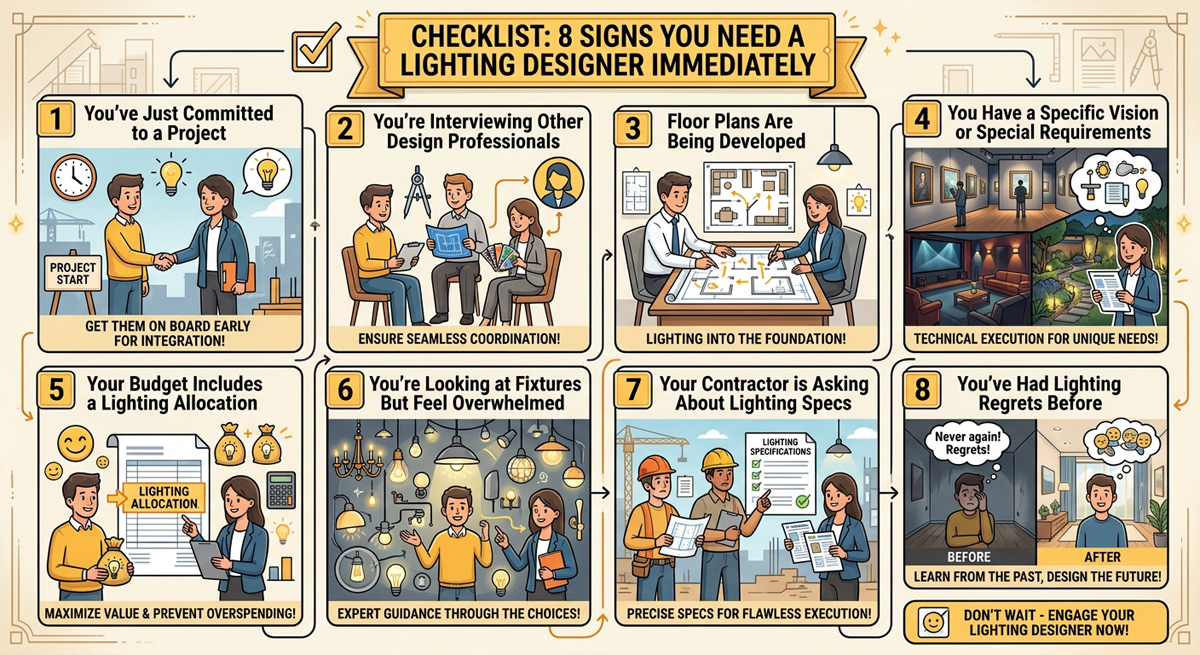
8 Signs It's Time to Hire a Lighting Designer Right Now
Not sure if it’s the right moment? Here are clear indicators that you should pick up the phone today:
1. You’ve Just Committed to a Project:
Whether it’s signing with an architect, purchasing a property, or deciding to renovate—this is the golden moment. You have maximum flexibility and time is on your side.
2. You’re Interviewing Other Design Professionals:
If you’re selecting an architect, interior designer, or general contractor, this is the perfect time to add a lighting designer to the conversation. Starting together means better collaboration.
3. Floor Plans Are Being Developed:
Lighting needs should influence layout decisions—outlet locations, switch placement, ceiling configurations. Once plans are finalized, these decisions become fixed and expensive to change.
4. You Have a Specific Vision or Special Requirements:
Art collections, home theaters, wine cellars, smart home integration, circadian lighting—specialized goals require extra planning time. Don’t wait until it’s too late to achieve what you really want.
5. Your Budget Includes a Lighting Allocation:
If you’ve set aside funds for quality lighting, ensure that money is spent wisely through professional design rather than last-minute scrambling for fixtures that “will work.”
6. You’re Looking at Fixtures But Feel Overwhelmed:
Browsing lighting showrooms or websites and feeling lost? That’s a clear signal that professional guidance will save you time, money, and frustration.
7. Your Contractor is Asking About Lighting Specs:
When your contractor or electrician asks for a lighting plan, fixture specifications, or switch locations, the clock is ticking. These questions mean decisions need to happen now.
8. You’ve Had Lighting Regrets Before:
If a previous project left you disappointed with the lighting, you know the pain of getting it wrong. This time, invest in getting it right from the start.
The Bottom Line: If any of these resonate with you, the best time to call is now. The second best time? Tomorrow. But definitely not next month—because in construction, next month might be too late.
What Happens If You Wait Too Long?
We believe in honest conversations, so let’s talk about what really happens when lighting design gets pushed to the back burner:
Scenario 1: Construction Documents Are Already Complete
What You Face:
- Redesign fees from architect/engineer: $500-$2,000+
- Potential project delays while documents are revised
- Design compromises to fit existing structural decisions
- Pressure to make rapid decisions without adequate time
Scenario 2: Construction Has Already Started
What You Face:
- Change orders adding 30-50% to electrical costs
- Possible demolition of already-completed work
- Strained contractor relationships and schedule impacts
- Rush decisions leading to suboptimal fixture choices
- Compressed design timeline affecting quality
Scenario 3: Ceilings Are Already Closed
What You Face:
- Limited to surface-mount and track solutions
- Destructive work required for recessed fixtures
- Aesthetic compromises in visible fixture locations
- Potential mismatch between lighting style and interior design
Scenario 4: Project Is Complete and Occupied
What You Face:
- Retrofit costs 2-3x higher than original planning
- Disruption to daily life or business operations
- Limited solutions (plug-in, surface-mount, track)
- Patching and painting after any modifications
- Living with compromises you hadn’t anticipated
A Real Example
“A client came to us after their $200,000 home renovation was nearly complete. They’d invested in beautiful finishes throughout but had let the contractor handle lighting. The result? A stunning kitchen with flat, shadowless lighting that made the gorgeous marble look like laminate. A living room where the carefully curated art collection was barely visible. A master bath where the vanity lighting made everyone look exhausted.
The retrofit cost $18,000 and required three weeks of additional work. Proper planning? Would have cost around $6,000 and been part of the original construction.
But the real cost wasn’t just financial—it was the frustration, the delays, and the knowledge that even with improvements, the results weren’t what they could have been with early involvement.”
The Delay Cost Calculator
| When You Engage | Additional Cost Factor | Typical Compromises |
|---|---|---|
| On time (design phase) | Baseline | None |
| 2 weeks late | +5-10% | Minimal, accelerated decisions |
| 1 month late | +15-25% | Some options eliminated |
| During construction | +30-50% | Significant compromises |
| After completion | +100-200% | Major limitations |
How to Take the First Step
Ready to explore lighting design for your project? Here’s what to expect and how to prepare:
What to Have Ready for Your First Call
Helpful to Provide:
- Brief description of your project (type, scope, goals)
- Current project stage (planning, design, construction)
- General timeline and target completion date
- Any existing drawings or design documents (if available)
- A sense of your budget range (doesn’t need to be exact)
You Don’t Need to Know:
- What fixtures you want—that’s what we help with
- Technical details about lighting—we’ll explain everything
- Exact budget figures—rough ranges are fine
- A complete design vision—we help develop that
What to Expect from an Initial Consultation
1. Discovery (15-30 minutes):
We discuss your project, goals, aesthetic preferences, and any specific requirements or challenges.
2. Assessment:
We evaluate your project stage, timeline constraints, and opportunities for lighting design impact.
3. Recommendations:
We provide initial thoughts on approach, timing considerations, and level of service that fits your needs.
4. Questions & Answers:
You ask anything on your mind—process, fees, timeline, our experience with similar projects.
5. Next Steps:
We outline how to proceed if you’d like to engage our services, with no pressure or obligation.
After the Consultation, You’ll Know:
- Whether professional lighting design is right for your project
- Approximate fee range for your scope of work
- Recommended timeline for your specific situation
- What deliverables and services would be included
- How we’d integrate with your existing project team
How a Lighting Designer Fits Into Your Project Team
A common concern: “I already have an architect and interior designer. Won’t adding another professional complicate things?”
The truth is, good lighting designers make everyone’s job easier—and everyone’s work look better.
Working with Your Architectady Started
- Lighting integrates with architectural features (coves, soffits, details)
- Coordinate ceiling designs and structural requirements
- Balance natural and artificial lighting strategies
- Technical documentation that fits architectural drawing sets
Working with Your Interior Designer
- Lighting supports and enhances the design vision
- Coordinate with material and finish selections
- Ensure furniture layouts and lighting work together
- Fixture aesthetics that complement interior style
Working with Your Electrical Engineer/Electrician
- Clear specifications for fixtures and controls
- Circuit requirements and load calculations
- Switch and dimmer locations
- Technical support during installation
Working with Your General Contractor
- Coordination of lighting rough-in with construction schedule
- Clear documentation for accurate bidding and installation
- Support for fixture procurement and lead times
- On-site coordination during installation phase
“A good lighting designer doesn’t replace your other professionals—they make everyone’s work better by adding a layer of expertise that most project teams are missing.”
Frequently Asked Questions About Timing
Is it ever too early to hire a lighting designer?
Almost never. Even at the earliest concept stages, a lighting designer can provide valuable input that shapes better outcomes. However, detailed design work typically begins once basic floor plans are established. Initial consultations can happen at any time—even before you’ve selected other design professionals. The earlier you connect, the more options remain available.
Can a lighting designer help if my project is already under construction?
Yes, though options may be more limited. If ceilings aren’t closed yet, there’s still opportunity to influence fixture placement and wiring. Even after completion, retrofit solutions, track lighting, and smart controls can significantly improve your lighting. We assess each situation individually and provide honest guidance about what’s achievable given your specific constraints.
How long does the lighting design process take?
Timelines vary by project complexity. A typical residential project takes 2-4 weeks for initial design concepts, with another 2-4 weeks for detailed documentation. Commercial projects may require 4-8 weeks or more. We always work to accommodate your construction schedule and can expedite when necessary, though rushed timelines may impact the depth of design exploration.
What if I don't have a final floor plan yet?
That’s actually a great time to connect. We can provide preliminary input that helps shape floor plan decisions, discuss general concepts, and be ready to dive into detailed design as soon as plans are finalized. Many clients find that early conversations help them make better overall design decisions about ceiling heights, room proportions, and window placements.
Should I hire a lighting designer before or after my interior designer?
Ideally, at the same time or shortly after. Lighting and interior design are deeply interconnected—your lighting should support and enhance your interior designer’s vision. The best results come when both professionals collaborate from early stages. However, we frequently join projects after interior design is underway and integrate seamlessly with existing design direction.
How do I know if my project is big enough to need a lighting designer?
It’s less about size and more about your goals. Even a single-room renovation can benefit from professional lighting design if you want optimal results. For new construction, major renovations, or any space where you’re investing significantly in finishes and furnishings, professional lighting design almost always pays for itself through better results and avoided mistakes.
The Bottom Line: Earlier is Always Better
In lighting design, there’s a simple truth that we see proven on every project:
“There’s no such thing as ‘too early’ to hire a lighting designer—only ‘too late’ and ‘just in time.'”
The best time to bring in a lighting designer was at the very start of your project. But the second best time? Today.
Every day that passes during active project development is a day of diminishing options. Walls get framed. Ceilings get closed. Decisions get locked in. The window of maximum opportunity is always closing.
But here’s the encouraging truth: wherever you are in your project timeline, there’s always something that can be done to improve your lighting outcomes. Early involvement creates magic. Late involvement creates improvement. And even post-construction retrofits can transform how a space feels and functions.
The key is to take action—to pick up the phone, send the email, or fill out the contact form. Have the conversation. Understand your options. Make an informed decision about what’s possible for your specific situation.
Because the one thing we can guarantee? You won’t regret starting that conversation. But you might regret waiting.
Ready to Discuss Your Project Timeline?
Whether you’re in the early dreaming stages or already watching construction progress, we can help you understand your options and make the most of wherever you are in the process.
A 15-30 minute conversation to discuss your project, assess timing, and explore what’s possible. No commitment required—just honest guidance.