This is a project we are proud to call our own. A contemporary luxury five-star hotel, designed from facade to bathroom mirror with a single intention — to make every guest feel, from the moment they arrive, that they have entered somewhere genuinely exceptional. Guocio was responsible for the complete hotel lighting design: concept, specification, fixture supply, and on-site commissioning across every space in the property.
What follows is the story of how it came together.
Light is the first language a building speaks. Before a guest reads the name above the door or feels the weight of the handle in their hand, they have already formed an impression — and that impression is made almost entirely by light.
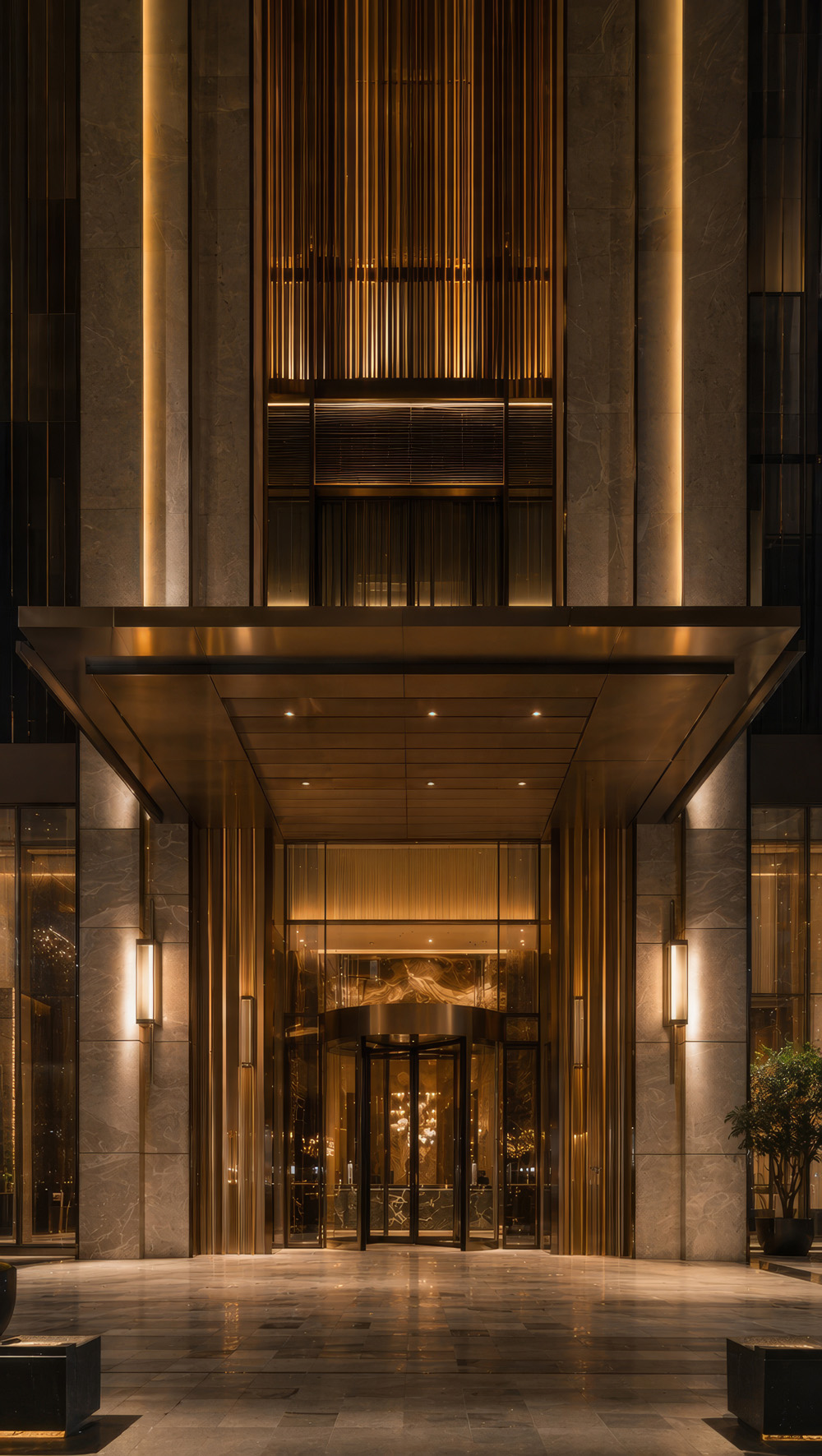
For the facade of this property, the design brief was deliberate restraint. The architecture itself — natural stone walls, champagne metal accents, precise geometric lines — needed no embellishment. What it needed was a lighting approach that would honour that restraint at night, when the building could no longer rely on daylight to do the work.
Wall-mounted fixtures were positioned to wash the stone facade in a consistent 3000K warmth, tracing the architectural geometry without competing with it. The entrance canopy is defined by a thin band of indirect light that frames the threshold — enough to signal arrival, not enough to break the quiet authority of the facade. The effect is a building that appears, at night, to glow from within.
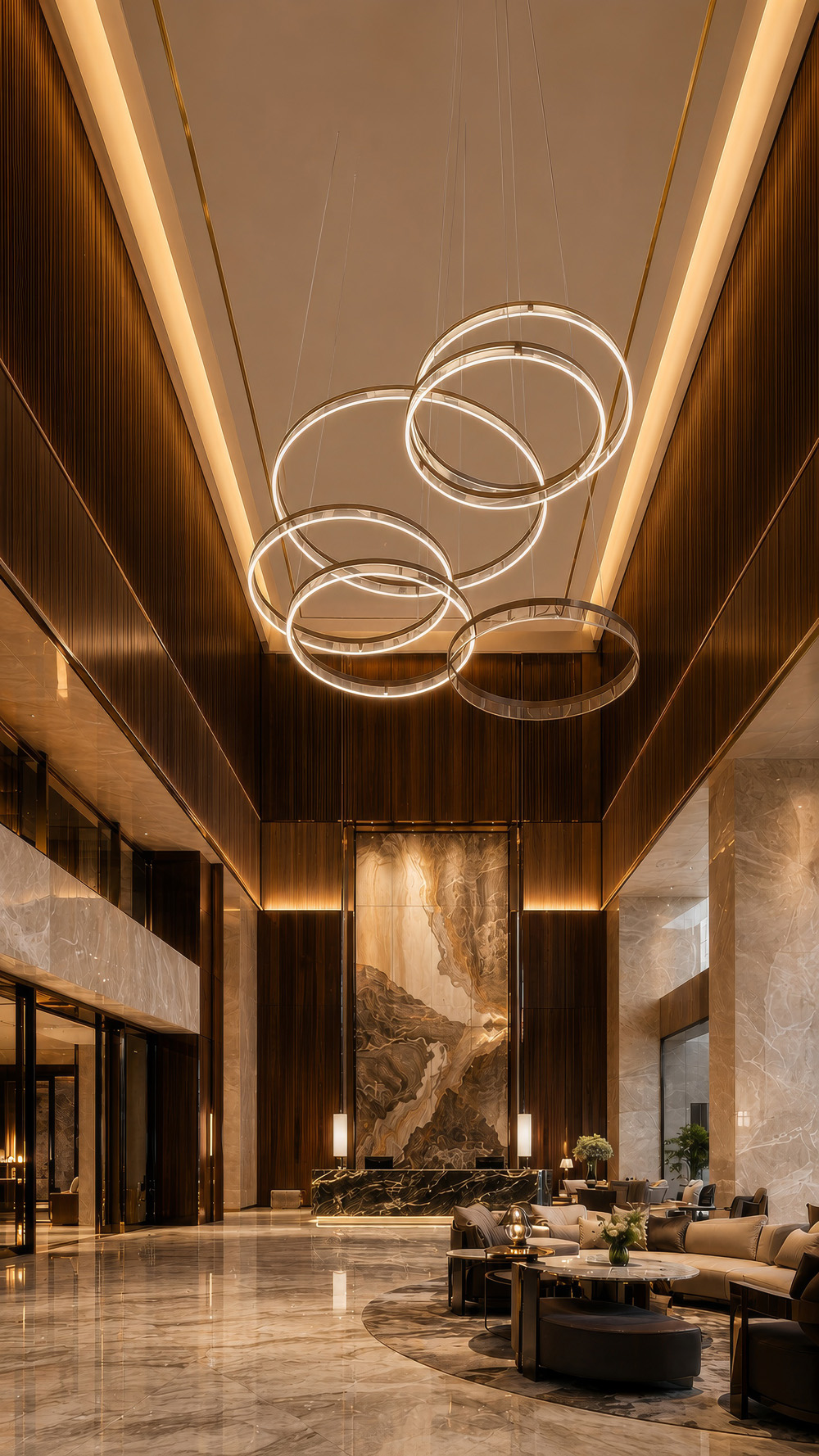
A hotel lobby needs a soul. In a double-height space like this one — where marble floors reflect upward and walnut-panelled walls draw the eye along the room — the risk is not that the space will feel too small. The risk is that it will feel too much like a container, and not enough like a place.
The answer was a single bespoke Guocio chandelier, suspended from the centre of the ceiling and scaled to command the full vertical dimension of the atrium. This is the hotel lobby chandelier as architectural event — not decoration placed inside a space, but a piece that defines the space around it. Guests entering the lobby orient themselves by it instinctively.
The surrounding hotel lobby lighting design works in deliberate contrast to this centrepiece: recessed downlights at low intensity, indirect coves that soften the ceiling plane, and floor-level accent strips that draw the eye toward the seating zones. The chandelier glows. Everything else supports it quietly. The result is a lobby that feels both dramatic and composed — the particular combination that distinguishes a five-star experience from one that merely tries to be.
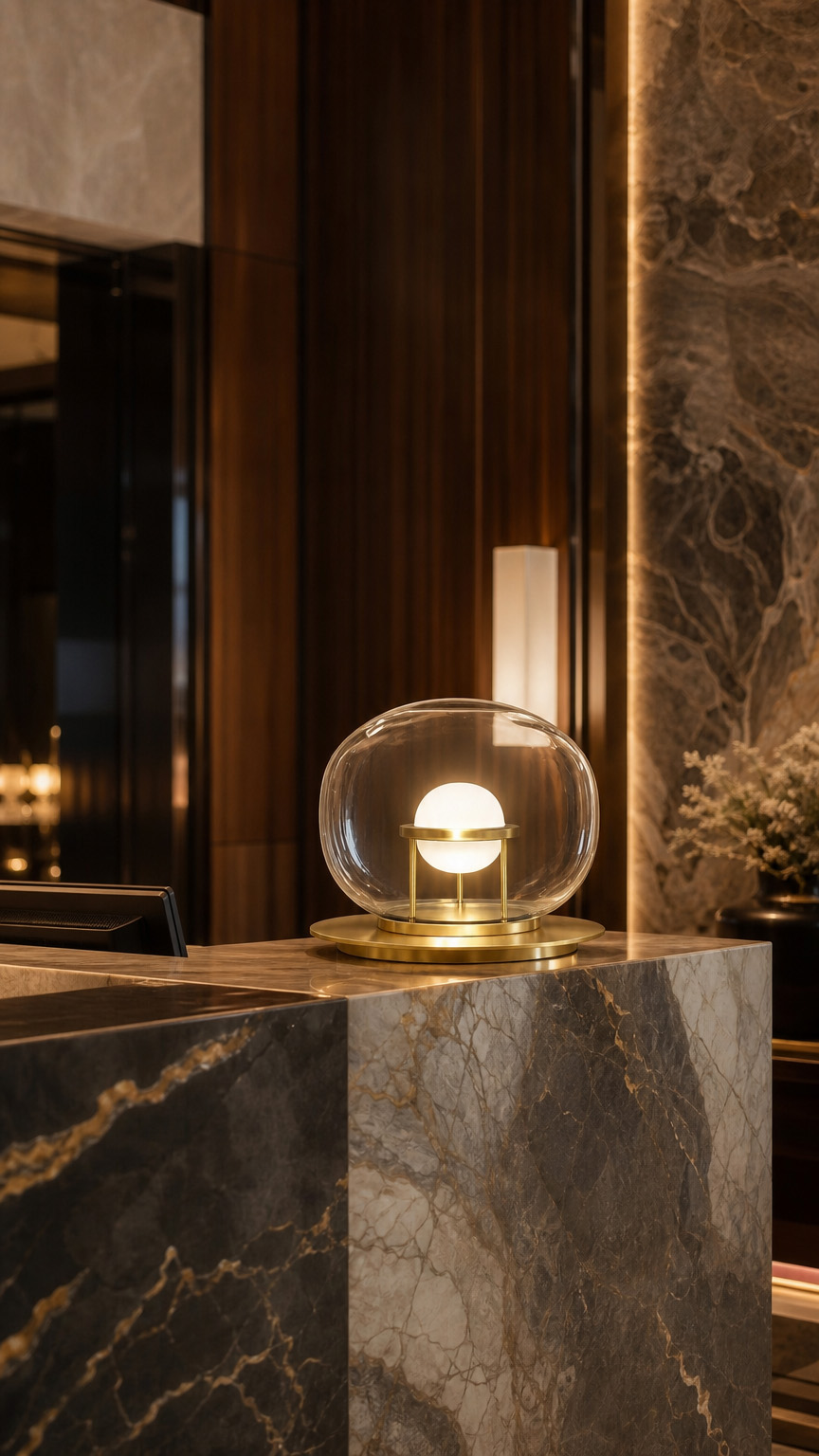
If the lobby chandelier is the hotel’s public gesture, the reception desk is its private one. This is where the scale of the building gives way to the scale of a conversation between two people — and the lighting has to make that transition feel natural.
A Guocio Peanut Table Lamp — 40cm wide, 30cm deep — sits at the centre of the marble reception counter. Its proportions were chosen carefully: present enough to serve as a visual anchor on a long counter, restrained enough not to interrupt the sightlines between guest and staff. The warm pool of light it casts downward onto the marble surface creates a zone of intimacy within the larger lobby space — a small, human-scaled moment of welcome embedded within the grandeur.
This detail is not incidental. In luxury hospitality, the memory of arrival is formed in seconds, and it is almost always formed in light.
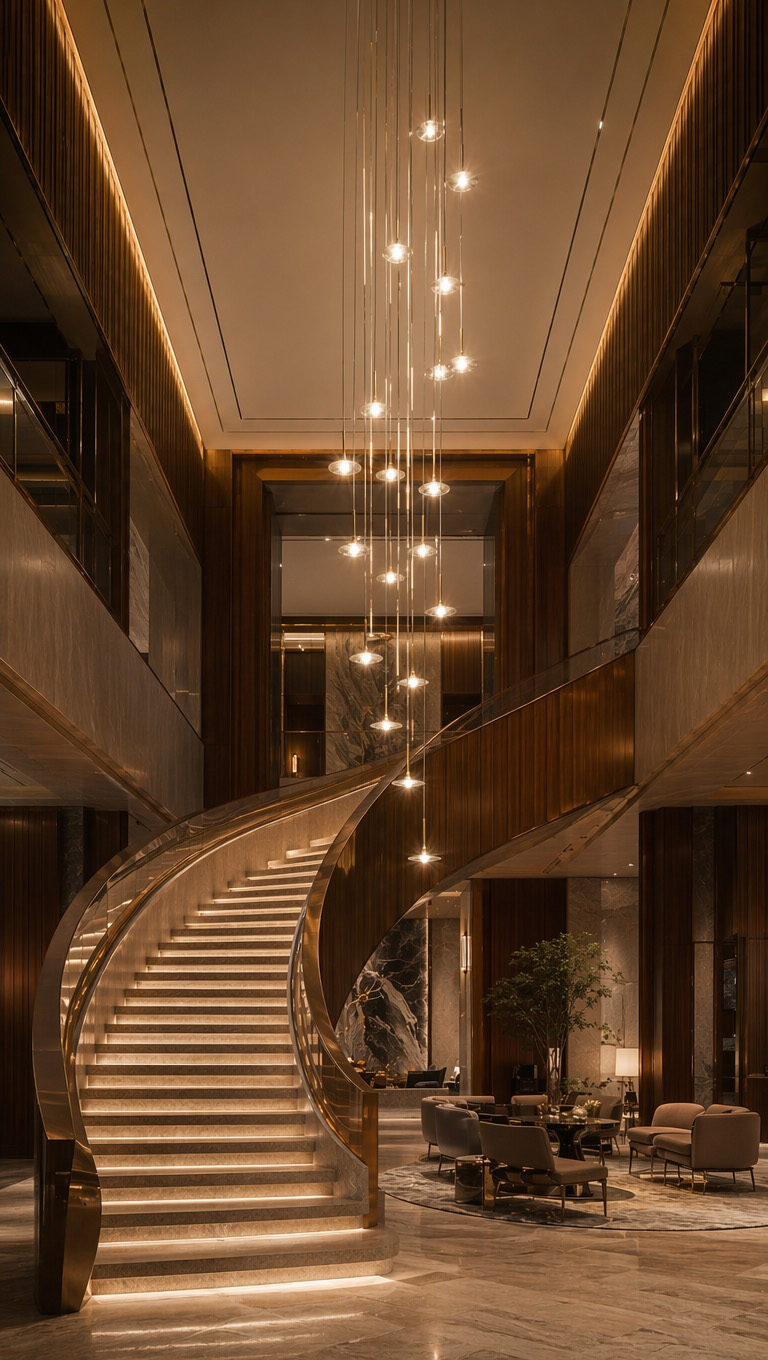
Every great hotel has one space that guests photograph before they have unpacked. In this property, it is the atrium staircase.
The brief called for a lighting installation that would respond to the architecture — a sculptural staircase spiralling upward through a two-floor void — and give it a visual centre of gravity. The solution was a cascading sequence of Guocio pendant fixtures suspended at varying heights through the full vertical extent of the atrium, creating what reads, from the ground floor looking up, as a waterfall of light moving through space.
Each pendant is individually positioned. The descent from upper floor to lower is not uniform — it follows a gentle rhythm that mirrors the curve of the staircase itself. At night, with the surrounding indirect lighting softened, the installation becomes the only thing you see. It is the kind of space that makes people slow down without knowing why.
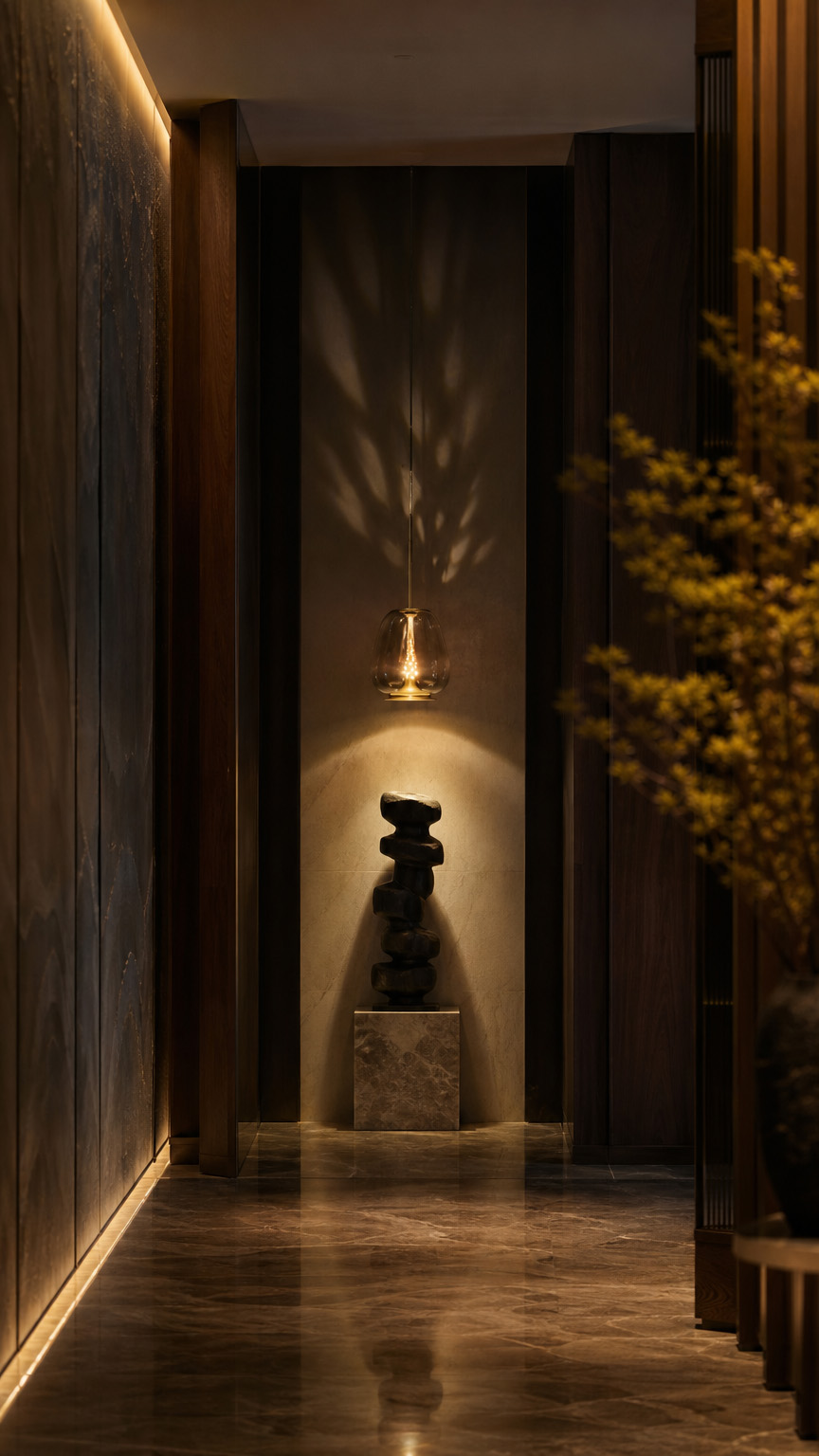
Hotel corridors are the spaces most guests pass through without noticing — which is precisely why they matter so much. A corridor that feels anonymous makes even the finest guest room feel like a room in a corridor. A corridor that has been designed — that has light and texture and a sense of direction — extends the hospitality experience all the way to the door.
Here, the corridor lighting works on two levels. The primary layer is a continuous run of soft indirect ceiling light, warm and even, that gives the passageway a calm, unhurried quality. The second layer is more specific: at the far end of each corridor, a recessed alcove holds a Guocio decorative pendant positioned directly above a piece of curated artwork. This combination — light, object, and the natural endpoint of a sightline — turns the end of a corridor into a small destination. Guests walk toward it without thinking. The journey to their room becomes, briefly, its own experience.
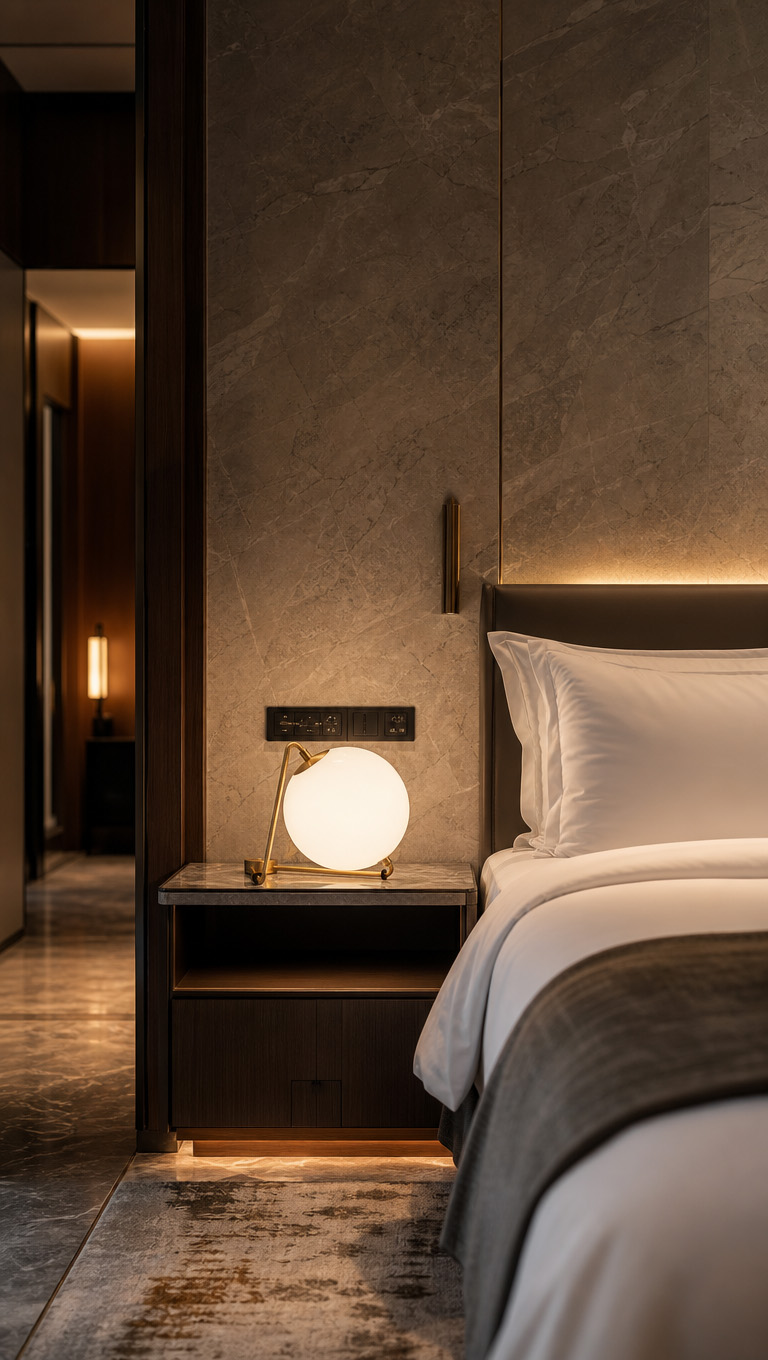
The guest room is where every decision made elsewhere in the hotel either holds together or falls apart. Public spaces can impress with scale, drama, and gesture. A bedroom must do something harder: it must feel personal. It must feel, despite having hosted hundreds of guests before this one, like a room that was made for exactly this person, tonight.
The hotel bedroom lighting design for this project was built around a single principle: light should support rest, not compete with it. The primary source is a Guocio Amber table lamp on each side of the bed, calibrated to 3000K — warm enough to lower cortisol, bright enough to read by, dimmable to whatever the guest needs at the end of their evening.
The room’s broader lighting — concealed ceiling coves, low-level floor accents — is designed to be invisible when the bedside lamps are on. The result is a space that contracts pleasantly as the evening progresses, narrowing the world down to the bed, the light, and nothing else that needs attention tonight.
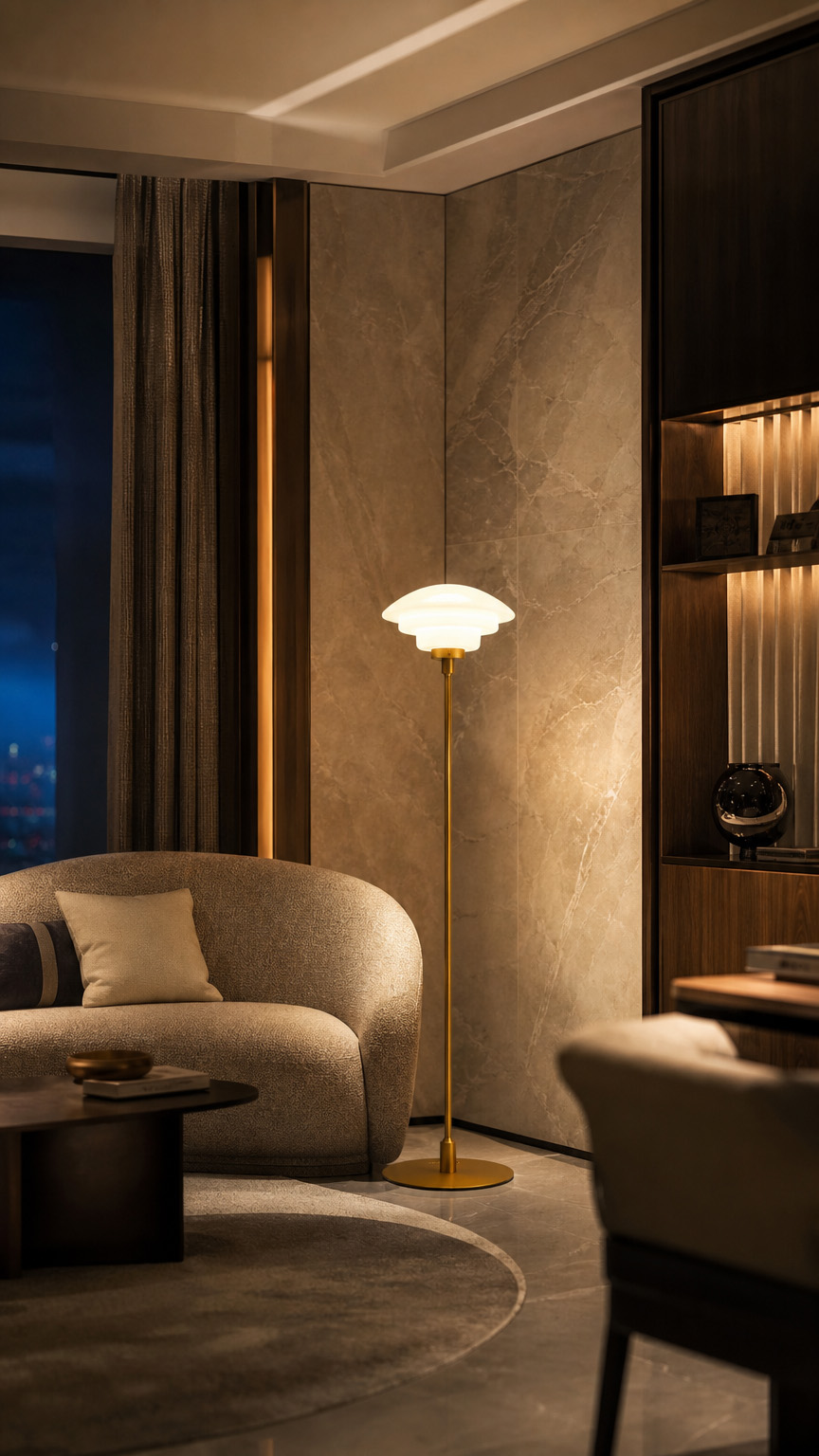
Not every guest comes to a hotel to sleep. Some come to think, to read, to be alone with themselves for a few hours in a room that doesn’t belong to their ordinary life. For those guests, the reading corner is the most important space in the room.
A Guocio floor lamp stands beside the lounge sofa — its position chosen to cast light at reading height without creating glare, its shade directing the beam downward and inward so that its pool of light defines a zone of privacy within the room. When this lamp is on and the rest of the room is dim, the chair beside it becomes, briefly, the most comfortable seat in the world.
The lamp itself is part of the hotel room lighting design logic: a second, independent light source that gives the guest genuine control over their environment. Not a feature. A considered act of hospitality rendered in light.
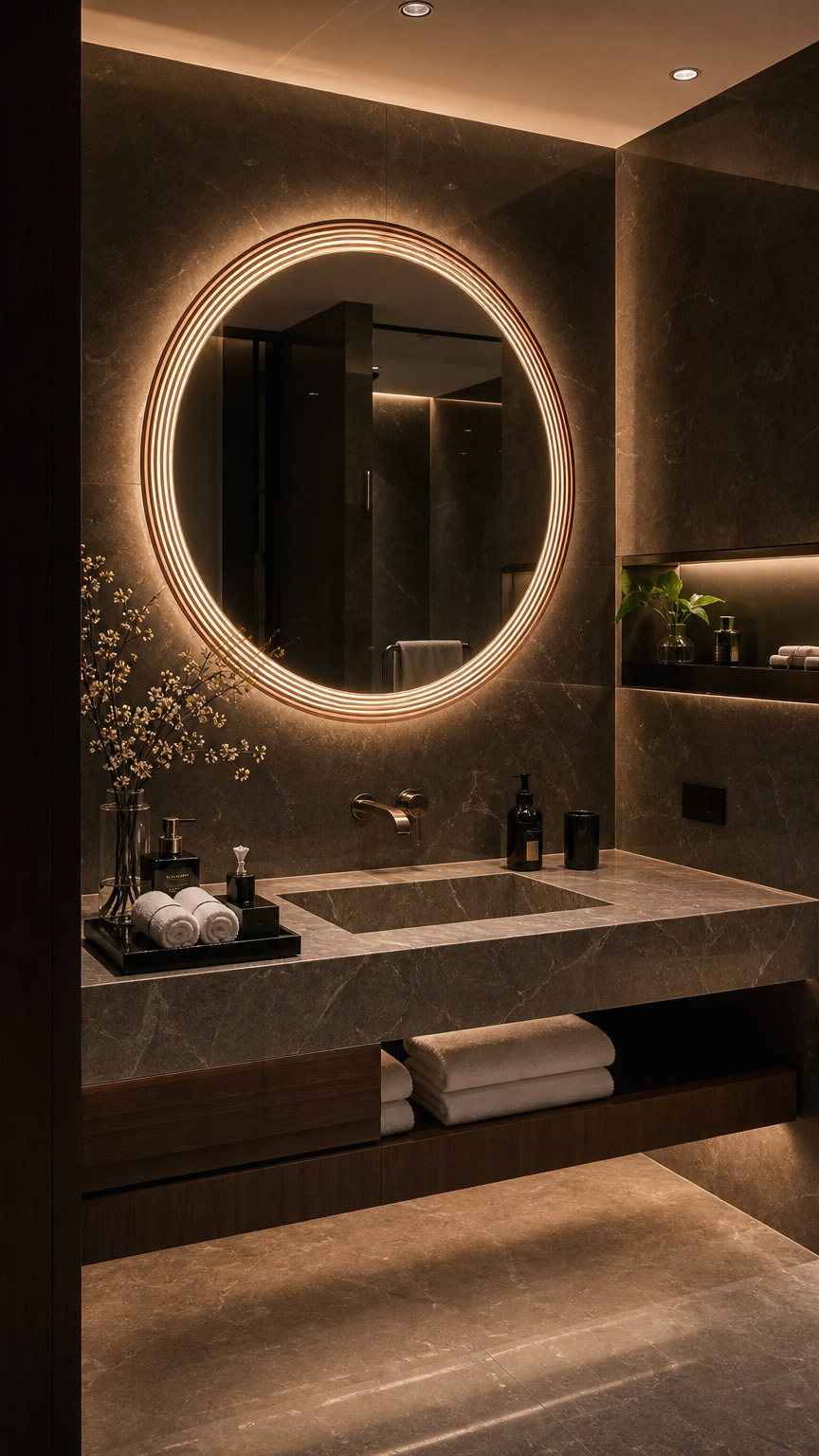
The bathroom mirror is the last thing a guest sees before they leave the room. It is also, in the logic of luxury hospitality, the most honest space in the hotel — the one where flattery is either delivered or exposed by the quality of the light.
The Guocio illuminated mirror fitted here emits a soft, even light at high colour rendering — CRI 95 or above — that eliminates the shadows and colour distortions that make standard bathroom lighting so unflattering. The marble vanity surfaces beneath it catch the warmth without bleaching it. The overall effect is less clinical bathroom, more considered spa: a space where the light makes you look, and feel, slightly better than you expected.
It is the smallest space in the hotel. It is also, for many guests, the one they remember most specifically. That is the nature of a well-placed detail: it disproportionately shapes the whole.
In every hotel project we take on, there is a question we return to at each stage: does this light know when to disappear? In a lobby, a chandelier must be unmissable. In a corridor, the light must feel continuous and calm. In a bedroom, it must recede until the guest is barely aware of it. The skill is not in the brightness — it is in the restraint. This project gave us the opportunity to practise that restraint across every scale, from a building facade to a bathroom mirror. We are grateful for clients who understand that the finest hospitality experiences are built, in large part, from the quality of light that guests can’t quite explain, but will never quite forget.
— Guocio Design Team