Your company just finished a major renovation. Every light fixture is the latest LED model, brightness is perfect, and color temperature is scientifically optimized. Yet employees still complain: “My eyes hurt,” “The screen is too harsh,” “I am getting headaches.”
What went wrong? The answer lies in a single metric that most people have never heard of: UGR (Unified Glare Rating).
UGR is an international standard developed by the International Commission on Illumination (CIE). It quantifies the level of discomfort glare in a space on a numerical scale (typically 10-30). The lower the number, the less glare. As a professional lighting consultant, Guocio knows that UGR is not optional—it is a mandatory standard for world-class Office lighting design. Ignore it, and your team’s productivity will plummet.
What is UGR? The Science Behind the Number
UGR does not measure brightness. It measures discomfort. The calculation takes into account the luminance of the light source, its position relative to the viewer’s line of sight, the background brightness, and the size of the glare source.
The UGR Scale:
- UGR < 16: Ultra-low glare (surgical suites, precision laboratories)
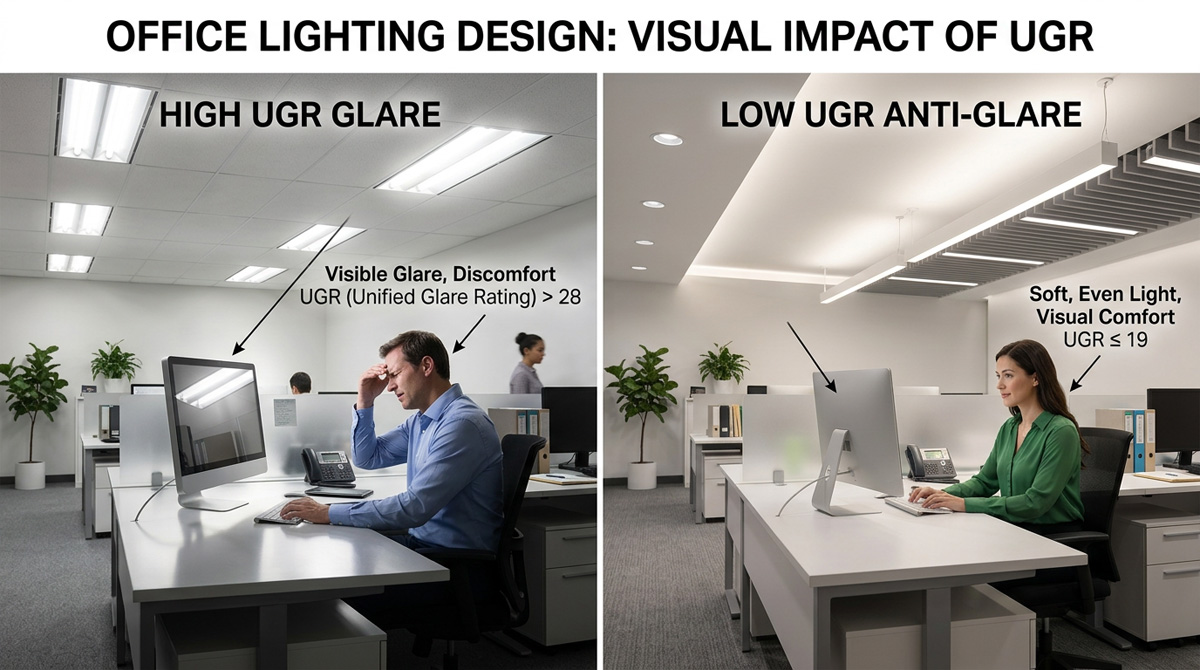
- UGR < 19: Low glare—the gold standard for offices and classrooms
- UGR < 22: Moderate glare (corridors, lobbies)
- UGR > 25: High glare (unsuitable for prolonged work)
European standard EN 12464-1 explicitly mandates that computer workstations must achieve UGR < 19. Exceeding this threshold leads to visual fatigue, reduced concentration, and chronic migraines.
Why Traditional Office Lights Fail the UGR Test

Most legacy office lighting systems dramatically fail UGR standards for three reasons:
- Exposed Bulbs: Direct visibility of the light source can push UGR above 25.
- Glossy Reflectors: While these boost brightness, they create harsh secondary reflections that spike UGR.
- Poor Positioning: Fixtures installed directly in the employee’s 45-degree field of vision cause direct glare.
How to Achieve UGR < 19: The Guocio Strategy
Top-tier Commercial Lighting Solutions require a multi-faceted approach:
Strategy 1: Choose Low-UGR Fixtures. Select Ceiling Lamps equipped with high-quality diffusers or anti-glare louvers. Alternatively, use indirect Pendant Lamps that bounce light off the ceiling, dramatically lowering UGR.
Strategy 2: Proper Installation Angles. Fixtures should never be installed where employees can see them by simply looking up. Professional Office lighting Solutions calculate precise sightline angles to ensure comfort.
Strategy 3: Layered Lighting. Relying on a single powerful overhead source creates high UGR. Combining ambient ceiling lights with personal Table Lamps distributes brightness evenly, slashing glare.
UGR Beyond the Office: Different Spaces, Different Standards
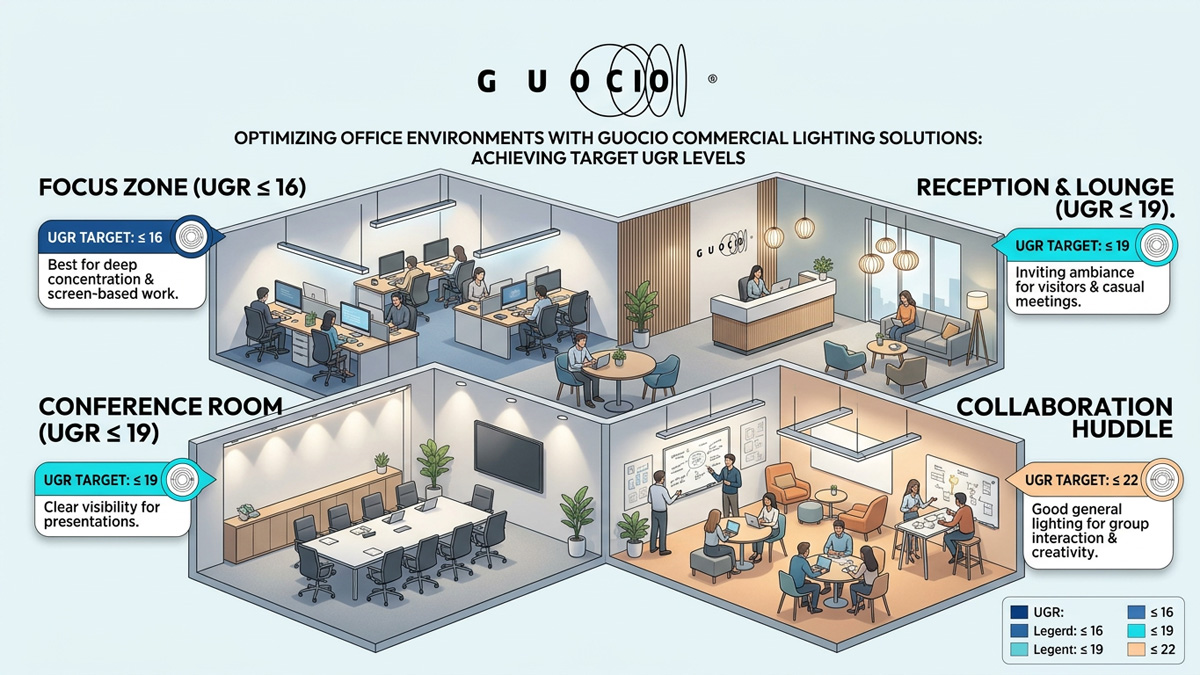
UGR is not exclusive to offices—it is a foundational metric for all exceptional lighting design services:
- Conference Rooms (UGR < 19): Maintains focus while being flattering for video calls.
- Lounges & Breakout Areas (UGR < 22): Standards can relax slightly here. Use aesthetically pleasing Wall Lamps or elegant Floor Lamps to create warmth.
- Corridors (UGR < 25): No prolonged work happens here. Use decorative Spot Lights for accent lighting.
The WFH Challenge: Managing UGR at Home
When your house doubles as your office, Home lighting design typically ignores UGR entirely. Residential fixtures are designed for ambiance, not ergonomics.
- The Living Room: Standard chandeliers can have a UGR exceeding 28! A superior living room lighting design turns off harsh overhead lights during work hours. Instead, use a soft, adjustable Floor Lamp positioned to provide indirect illumination, creating low-UGR living roomlighting Solutions.
- The Kitchen: Exposed island pendants without frosted shades create severe laptop screen reflections. Upgrade your kitchen lighting design with diffused-glass fixtures to ensure comfortable kitchen lighting Solutions.
- The Bedroom: Working in bed is already ergonomically disastrous, but using a bare overhead bulb (UGR > 30) makes it unbearable. Proper bedroom lighting design demands a shielded, adjustable Wall Lamp or focused reading Spot Light, lowering UGR to a healthier < 22 for safe bedroom lighting Solutions.
Protect Your Team's Vision with Guocio
UGR < 19 is not a luxury; it is a necessity for protecting employee eyesight and maximizing productivity. Achieving it requires expert fixture selection, precise installation angles, and layered lighting strategies.
Not sure what your office or home workspace’s UGR rating is? Contact Guocio today to book professional lighting design services. We offer on-site UGR measurement and will craft bespoke Commercial Lighting Solutions to make your space truly comfortable and efficient!