Walk into two different five-star hotels and you can usually tell, within seconds, which one will stay with you. It’s rarely the artwork. It’s rarely even the furniture. In almost every case, the difference is light.
Professional hotel lighting design is one of the most consequential — and most frequently underestimated — investments a hospitality project can make. Done well, it becomes invisible: guests simply feel that a space is warm, considered, and worth remembering. Done poorly, no amount of marble or art can fully compensate.
This guide breaks down what hotel lighting design actually involves, the principles that separate forgettable hotels from unforgettable ones, and how the approach plays out across every space in a property — illustrated with real moments from a recent five-star project delivered by Guocio.
What Is Hotel Lighting Design?
Hotel lighting design is the discipline of planning, specifying, and commissioning the complete lighting strategy for a hospitality property — covering everything from the building facade to the smallest detail inside a guest bathroom. It is not simply choosing attractive fixtures. It is the technical and creative work of deciding how light should behave in every space a guest will encounter, and ensuring that behaviour holds up reliably, night after night, for years.
A complete hotel lighting design typically spans:
- Building facade and entrance lighting
- Lobby, reception, and public circulation areas
- Restaurants, bars, and event spaces
- Corridors and transitional zones
- Guest room bedrooms and bathrooms
What separates hotel lighting from residential lighting design is the combination of three demands that rarely apply at home: brand consistency across dozens or hundreds of rooms, operational durability under continuous commercial use, and the need to support an enormous range of guest behaviours — business, rest, romance, celebration — within the same physical space. This is the kind of complexity that a dedicated lighting design service is built to manage.
The 5 Principles of Five-Star Hotel Lighting
Across every successful hospitality lighting project, the same underlying principles tend to show up. They are not stylistic choices — they are the structural logic that makes a space feel five-star rather than merely expensive.
1. Brand Consistency
The color temperature, the warmth, the overall lighting language of a property should feel continuous from the moment a guest sees the facade to the moment they switch off their bedside lamp. A consistent 3000K warm white throughout, for example, becomes a quiet but unmistakable signature — guests may never consciously notice it, but they feel its absence immediately in properties that get it wrong.
2. Layered Lighting
No single light source can do everything a space needs. Ambient light fills the room generally; task light supports specific functions like reading or grooming; accent light draws attention to architecture, art, or texture. A lobby, a bedroom, even a corridor — all perform better with this three-layer logic applied deliberately, rather than relying on one dominant source.
3. Scene Flexibility
A hotel lobby that hosts a quiet morning coffee crowd at 8am and a lively evening reception at 8pm needs lighting that can shift convincingly between both. The same applies to guest rooms moving from daytime brightness to nighttime wind-down. Dimming, zoning, and scene programming are not luxuries in commercial lighting solutions for hospitality — they are baseline requirements.
4. Guest Comfort First
High color rendering (CRI 90 and above), glare-free fixture positioning, and circadian-friendly warm tones in guest rooms all serve one goal: making the guest feel genuinely comfortable, not just visually impressed. Comfort is harder to engineer than drama, and it matters more to repeat guests and online reviews.
5. Operational Durability
A hotel fixture isn’t replaced as casually as a residential one. It needs to perform reliably under nightly use, integrate cleanly with building management and control systems, and remain serviceable without disrupting operations. This is where professional lighting design services diverge sharply from a purely decorative approach — durability and maintainability are designed in from the start, not addressed after the fact.
Hotel Lighting Design, Space by Space
Principles matter, but they only become real once applied to an actual space. Here is how professional hotel lighting design plays out across the key zones of a property — illustrated with moments from a recent five-star hospitality project completed by Guocio.
Facade & Entrance
The facade is a hotel’s first sentence. Wall-mounted fixtures washing natural stone in warm light, combined with a defined band of illumination at the entrance canopy, signal arrival without overwhelming the architecture. This is hotel lighting design at its most restrained — and often its most important, since it shapes the guest’s expectations before they’ve taken a single step inside.
The Lobby
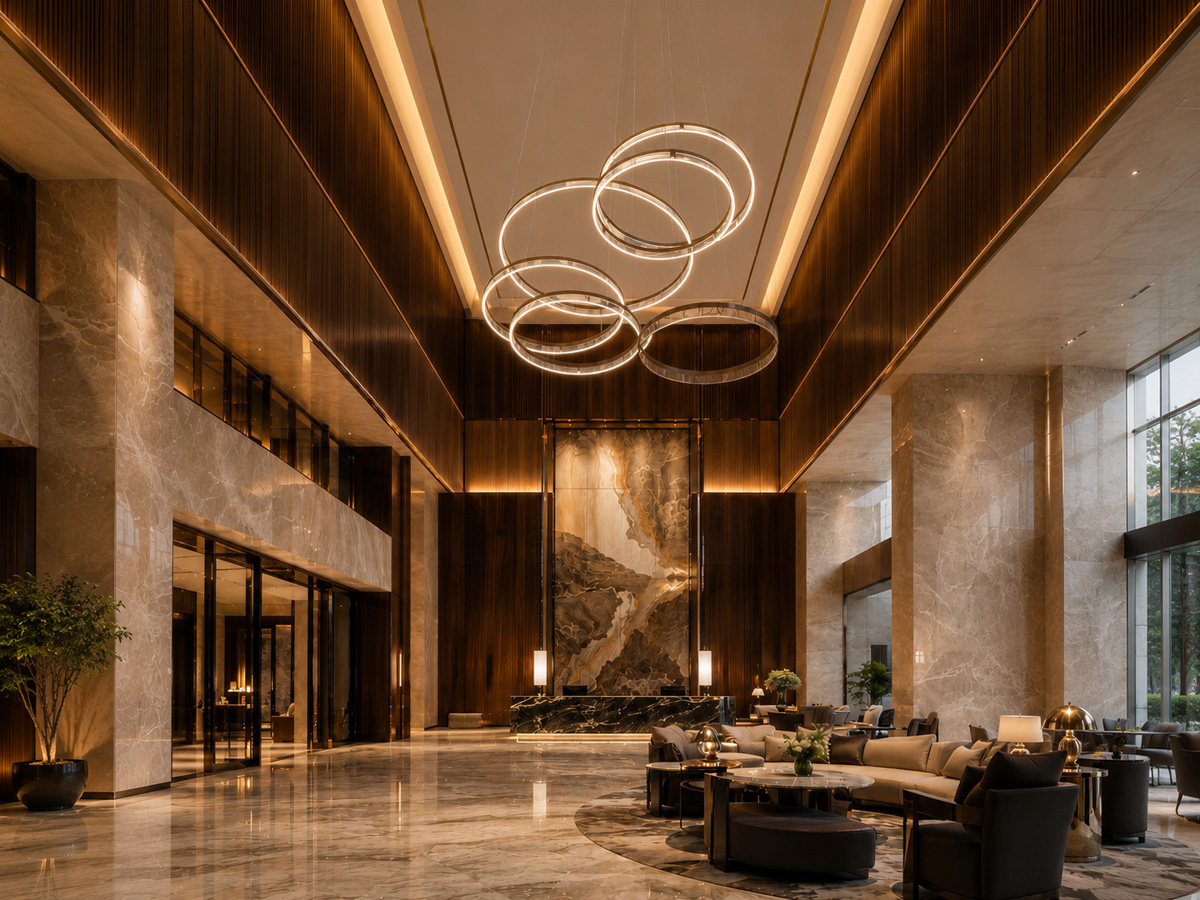
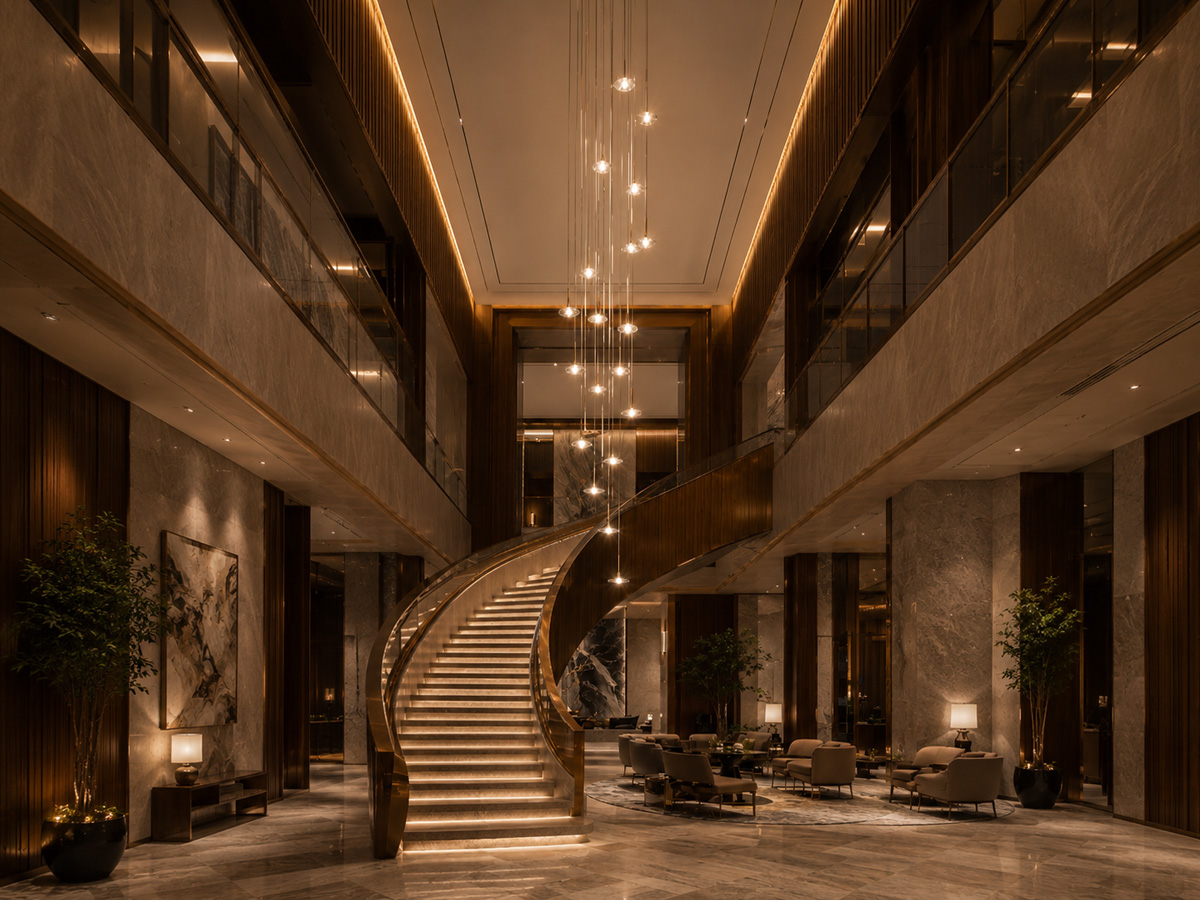
In a double-height lobby, the central challenge is scale. A hotel lobby chandelier sized for the architecture — rather than simply placed within it — becomes the space’s natural focal point, giving guests an instant sense of orientation and occasion. The surrounding hotel lobby lighting design should work quietly in support: recessed downlights, soft ceiling coves, and low accent strips that frame the centrepiece without competing with it.
Reception & Welcome Areas
At the reception desk, scale shifts from architectural to human. A well-proportioned table lamp on the counter creates a warm, intimate pool of light that supports the brief, personal exchange between guest and staff — a small but disproportionately memorable detail in the first minutes of any stay.
Atrium & Staircase
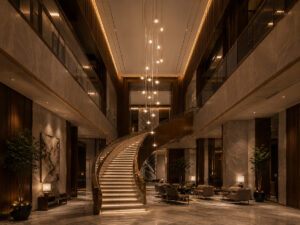
Where a property includes a dramatic vertical space — a staircase, an atrium void — lighting has the opportunity to become the architectural event itself. Cascading pendant installations suspended through multiple floors can transform a circulation space into the single most photographed corner of the hotel, simply by giving the eye somewhere deliberate to travel.
Corridors
Often the most neglected zone in hospitality lighting design, corridors deserve more attention than they typically receive. Continuous, even, indirect lighting maintains a calm pace, while a single considered moment — a recessed fixture above artwork at a corridor’s end, for instance — gives the space a sense of destination rather than mere transition.
Guest Room Bedroom
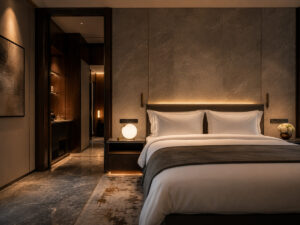
The bedroom is where hotel room lighting design earns its keep. The single most important principle here: light should support rest, not compete with it. Bedside table lamps calibrated to 3000K — warm enough to encourage winding down, bright enough to read by — paired with concealed ambient lighting that recedes to near-invisibility in the evening, create a room that feels personal and calming rather than simply well-lit. For a full zone-by-zone breakdown of guest room lighting, see our dedicated guide to hotel room lighting design, or for the sleep science behind these color temperature choices, see hotel bedroom lighting design.
Reading Corners & Lounge Areas
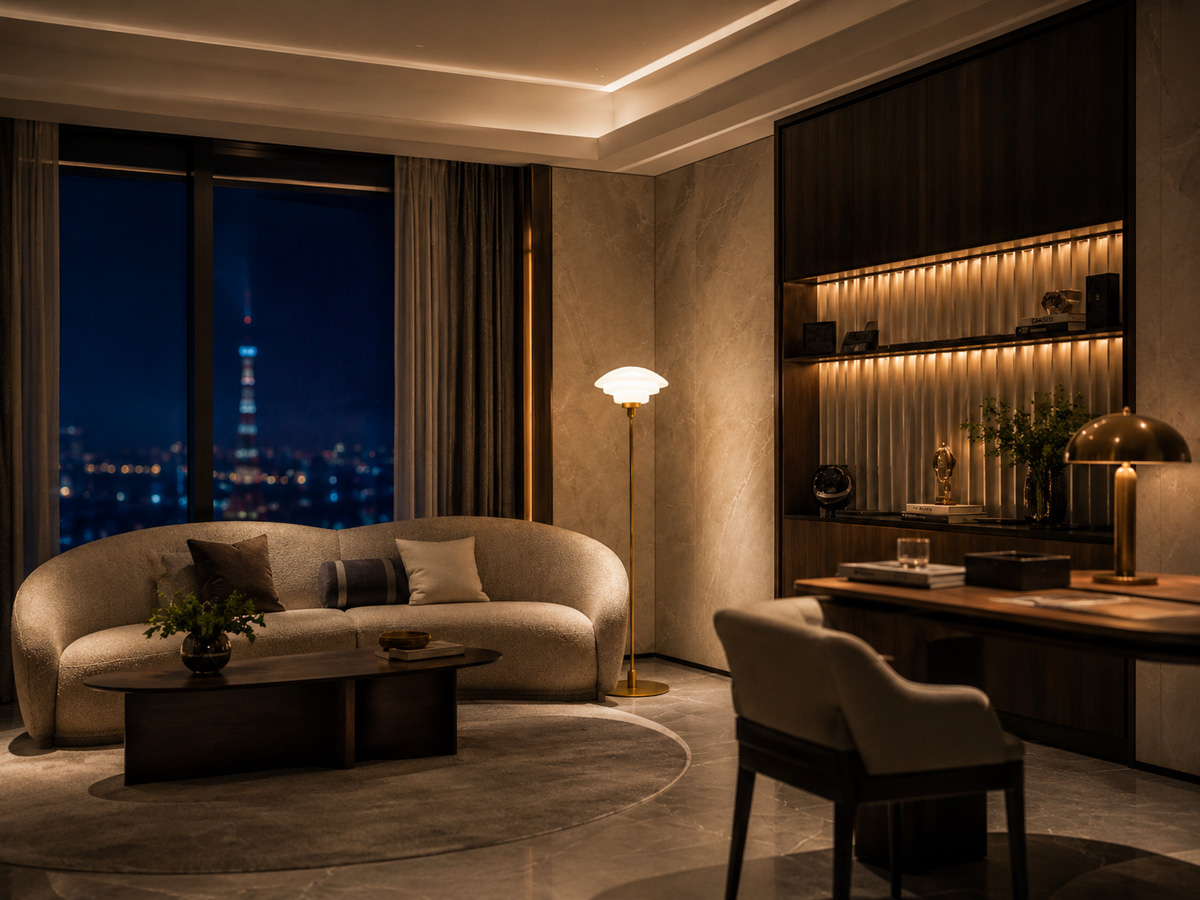
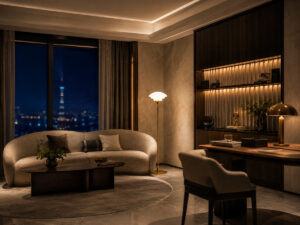
A floor lamp positioned beside a lounge chair gives guests a second, independent light source — a small act of genuine hospitality that lets them control their own environment rather than relying solely on overhead lighting. This kind of detail rarely appears in marketing photography, but it shapes how a stay actually feels.
Bathroom & Mirror
The bathroom mirror is arguably the most underrated space in hotel room lighting design. High color rendering (CRI 95 or above), even and shadow-free illumination, and a soft warm tone transform a functional space into something closer to a spa experience — and it’s a detail guests notice precisely because so few properties get it right.
Case Reference: A Five-Star Hotel Project by Guocio
| Project Type | International Five-Star Hotel |
| Design Style | Contemporary Luxury |
| Color Temperature | 3000K Warm White Throughout |
| Scope | Facade · Lobby · Reception · Atrium · Corridor · Guest Room · Bathroom |
The full project tells the story space by space — from the chandelier that anchors the lobby to the bedside lamp that defines the bedroom. View the full case study →
Common Hotel Lighting Mistakes to Avoid
1. Relying on a Single Light Source
Recessed downlights alone, however well-positioned, will always read as flat and institutional. Without ambient, task, and accent layers working together, even an expensively finished space can feel underwhelming.
2. Inconsistent Color Temperature
A lobby at 4000K, a corridor at 3500K, and a guest room at 2700K creates a disjointed experience that undermines brand identity. Consistency in color temperature is one of the simplest, most effective ways to make a property feel coherently designed.
3. Neglecting Transitional Spaces
Corridors, stairwells, and lift lobbies are often treated as afterthoughts. But these are the spaces guests spend the most cumulative time moving through — and poor lighting here breaks the continuity of an otherwise excellent design.
4. Choosing Fixtures on Looks Alone
A beautiful fixture that fails after eighteen months of nightly commercial use, or that cannot be serviced without disassembling a ceiling, creates ongoing operational costs that quickly outweigh its aesthetic appeal. Commercial-grade durability has to be part of the selection criteria from day one.
5. Bringing Lighting In Too Late
When lighting design is treated as a finishing touch rather than an integrated part of the architectural and interior design process, the result is almost always compromise — fixtures forced into positions that weren’t designed for them, or ceiling plans that can’t accommodate the ideal layout. The earlier a lighting design partner is involved, the better the final result.
Frequently Asked Questions
What color temperature is best for hotel lighting?
3000K warm white is the industry standard across most hotel spaces — facades, lobbies, corridors, and guest rooms alike. It creates a consistently warm, welcoming atmosphere while remaining bright enough for practical use, and it renders skin tones and natural materials flatteringly. Some task-focused back-of-house areas may use slightly cooler tones, but public and guest-facing spaces in luxury hotels almost always default to warm white.
How is hotel lobby lighting different from other commercial spaces?
Hotel lobby lighting has to do more than illuminate — it has to set the tone for the entire guest experience within seconds of arrival. Unlike a typical commercial lobby, a hotel lobby lighting design usually combines a dramatic feature element, such as a chandelier, with carefully layered ambient and accent lighting that supports seating, reception, and circulation simultaneously, all while operating reliably for years.
What kind of chandelier is suitable for a hotel lobby?
A hotel lobby chandelier needs to be scaled to the architecture, not just the room. In a double or triple-height atrium, the fixture must be large and considered enough to anchor the full vertical space, while meeting commercial-grade durability, safe maintenance access, and compatibility with dimming and building control systems. Bespoke or custom-manufactured chandeliers are common in five-star properties precisely because standard catalogue sizing rarely matches the scale required.
How do I choose lighting for a hotel bedroom?
Hotel bedroom lighting design should prioritize rest over drama. A warm 3000K color temperature, dimmable bedside table lamps positioned at reading height, and concealed ambient lighting that can be dimmed to near-invisibility in the evening are the core elements. The goal is a room that feels personal and calming, with the guest in full control of the atmosphere as the evening progresses.
How does Guocio approach hotel lighting design projects?
Guocio delivers end-to-end hotel lighting design services — from initial concept and space-by-space strategy through to fixture specification, bespoke manufacturing, and on-site commissioning. Every project begins with a detailed brief covering the hotel’s brand positioning, material palette, and operational needs, ensuring the lighting scheme is integrated with the architecture from the earliest stage. See a recent project here.
Planning a Hotel Lighting Project?
Whether you’re developing a boutique property or a large-scale five-star resort, Guocio delivers complete hotel lighting design services — from concept to on-site commissioning, with full bespoke fixture manufacturing capability.
Start a Hotel Lighting Consultation →
View Our Hotel Lighting Case Study →