You are standing in a lighting store, trying to choose a bulb for your floor lamp. The store assistant asks: “How many watts do you need?” You hesitate—60 watts? 100 watts? The brighter the better? But here is the truth that most people do not know: in the LED era, wattage is no longer a reliable measure of brightness. The rules of buying light bulbs have fundamentally changed.
Wattage measures electricity consumption, not light output. A 10W LED bulb can produce more light than a 60W incandescent bulb. The old “wattage = brightness” thinking is obsolete. As a professional lighting consultant, Guocio will upgrade your thinking from “watt logic” to “lumen logic,” ensuring your Floor Lamp buying decisions are precise, informed, and never regretted.
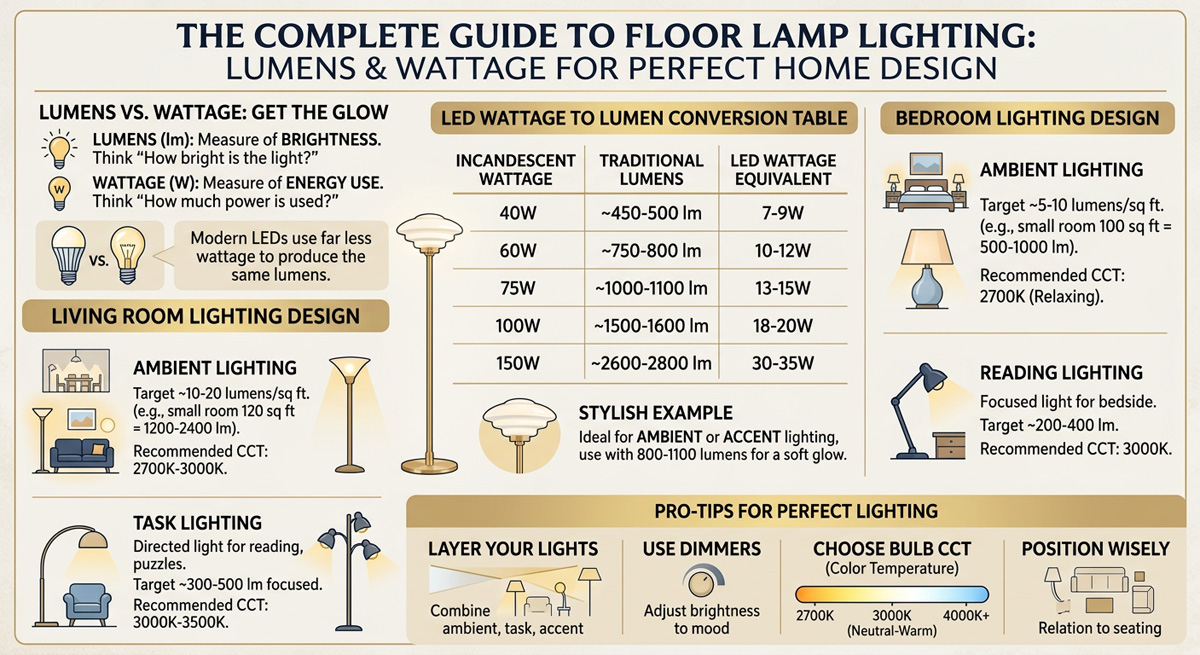
Watts vs. Lumens: The Fundamental Distinction
Watts (W): Measures how much electricity a bulb consumes. In the LED age, this is a secondary metric for brightness purposes.
Lumens (lm): Measures the actual quantity of light a bulb produces. This is the correct metric for determining brightness.
The LED revolution has permanently decoupled wattage from brightness:
- Traditional incandescent bulbs: approximately 10-15 lumens per watt
- Compact fluorescent lamps (CFL): approximately 40-70 lumens per watt
- Modern LED bulbs: approximately 80-130 lumens per watt
The conclusion is striking: the brightness that once required a 60W incandescent bulb now requires only a 6-9W LED. This is why the question “what wattage do I need?” is the wrong starting point. The right question is: “how many lumens do I need?”
The LED Conversion Chart: Incandescent to LED
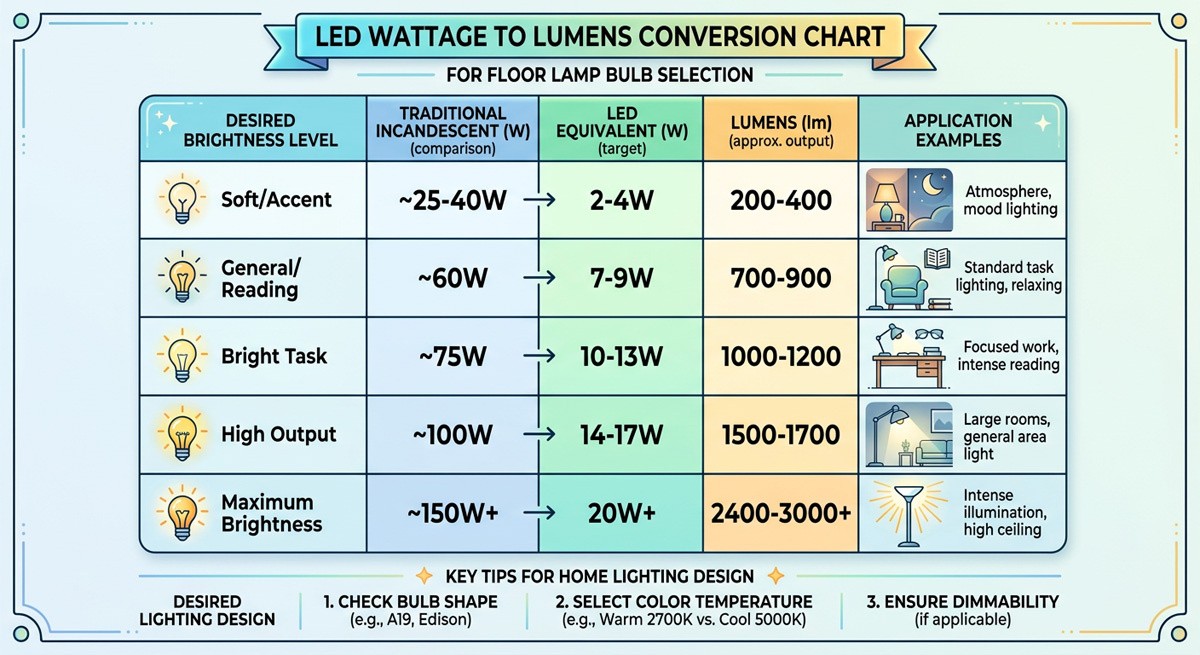
| Incandescent (W) | LED Equivalent (W) | Light Output (lm) | Best Use |
|---|---|---|---|
| 25W | 2-4W | 250 lm | Decorative accent only |
| 40W | 4-6W | 450 lm | Mood and atmosphere |
| 60W | 6-9W | 800 lm | Reading and general use |
| 75W | 9-12W | 1100 lm | Bright reading, task work |
| 100W | 12-16W | 1600 lm | Primary room lighting |
How Many Lumens Do You Actually Need?
Floor lamps are supplementary fixtures in most rooms—they work alongside Ceiling Lamps rather than replacing them. Therefore, the lumen requirement for a floor lamp depends primarily on its purpose:
- Ambient / Mood Lighting: 300-600 lm (4-8W LED)
Creating warm, inviting atmosphere. Not intended to provide reading-level brightness. Works with 2700K ultra-warm white for maximum coziness. - Reading Task Lighting: 700-1100 lm (9-13W LED)
Ensures at least 300-500 lux on the reading surface—the international standard for comfortable sustained reading without eye strain. - Primary Room Lighting (No Ceiling Lamp): 1200-2000 lm (15-25W LED)
When the floor lamp is the sole light source, it must compensate for the absent overhead fixture. Choose the upper end of this range for larger rooms. - Decorative / Accent Only: 150-400 lm (2-5W LED)
The lamp’s glow is the aesthetic point—not practical illumination. The dimmer and more atmospheric, the better.
Wattage and Lumens by Room
The Living Room
Living rooms typically feature an existing Ceiling Lamp as the primary ambient source, so the floor lamp’s role is supplementary. Choose 400-800 lm (5-10W LED) for atmosphere, or 800-1200 lm (10-15W LED) if it also serves sofa-side reading. For the most sophisticated living room lighting design, use two or three low-lumen floor lamps (400-600 lm each) at strategic positions rather than one excessively bright lamp—this creates the layered warmth that defines excellent living roomlighting Solutions. Combined with warm Table Lamps, these Living Room Lighting Ideas transform a standard room into a professionally lit sanctuary.
The Bedroom
Bedroom floor lamps should prioritize sleep-supporting light. For atmosphere and winding down, 300-600 lm (4-8W LED) at 2700K warm white is ideal. For a reading armchair lamp, increase to 700-1000 lm (9-13W LED). The critical rule: always pair the floor lamp with a dimmer switch so brightness transitions seamlessly from reading (100%) to sleep preparation (10%). Complement the floor lamp with soft Wall Lamps for a complete layered bedroom lighting design with restorative bedroom lighting Solutions.
The Home Office
A floor lamp beside a home office desk serves as supplementary side lighting—never directed at the computer screen. Choose 800-1200 lm (10-15W LED) at 3000K-4000K for alert, focused supplementary light. Pair with a dedicated Table Lamp on the desk surface to collectively achieve the 500 lux standard required for professional Office lighting design.
The Kitchen and Dining Area
Floor lamps in kitchen and dining spaces primarily contribute decorative warmth rather than functional light. Choose a modest 300-600 lm (4-8W LED) at 2700K-3000K for a warm corner glow that complements the primary Pendant Lamps above the island or dining table. This completes the layered kitchen lighting design with sophisticated kitchen lighting Solutions.
The Dimmer Advantage: Why Flexible Lumens Beat Fixed Wattage
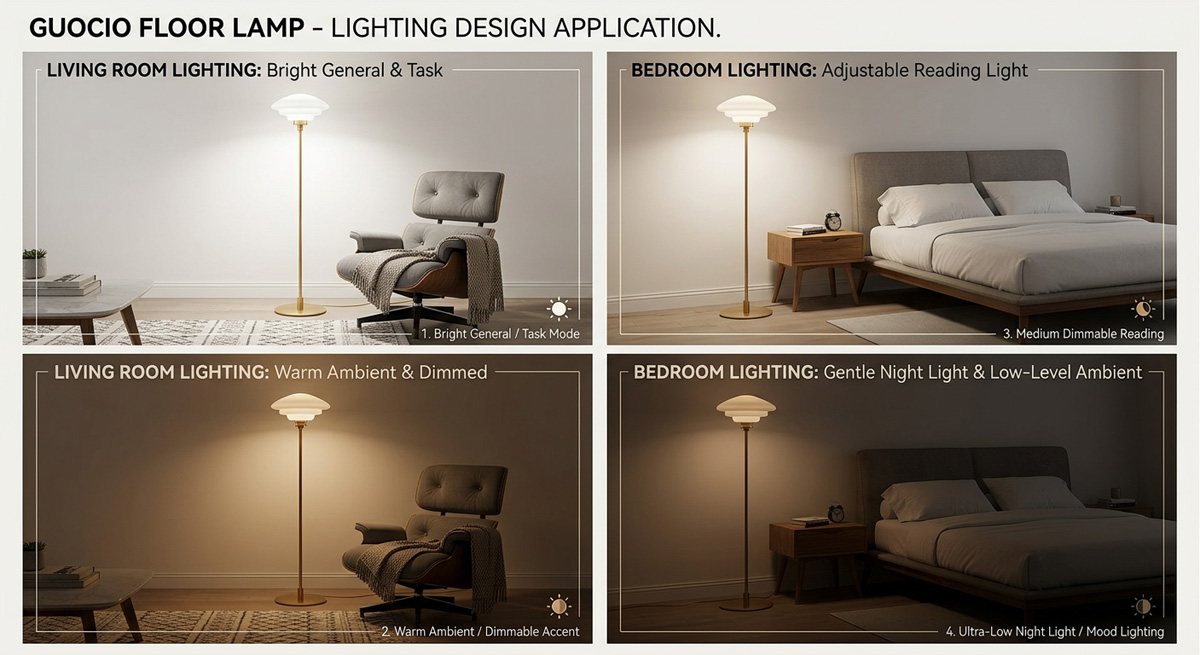
The single smartest investment you can make in any Home lighting design is a dimmable floor lamp. A fixed-wattage lamp forces you to choose one brightness that serves all situations—which never serves any situation perfectly.
A dimmable Floor Lamp with a 1000-lumen LED bulb seamlessly adapts:
- 100% brightness (1000 lm): Reading, crafting, detailed tasks
- 60% brightness (600 lm): Relaxed evening general use
- 30% brightness (300 lm): Movie watching, romantic dinner atmosphere
- 10% brightness (100 lm): Gentle night light, sleep preparation
Important Note: Not all LED bulbs support dimming. Always verify the “Dimmable” label on packaging before purchase. Using a non-dimmable LED bulb with a dimmer switch causes flickering, buzzing, and shortened bulb lifespan.
The Heat Factor: Safety and Maximum Wattage
Every floor lamp has a maximum wattage rating printed inside the shade or near the socket. Exceeding this limit with traditional incandescent bulbs creates excessive heat that can ignite the shade material—a genuine fire risk.
LED bulbs virtually eliminate this concern. A 9W LED produces the same 800 lumens as a 60W incandescent while generating approximately one-fifth of the heat. This is why modern Floor Lamps universally recommend LED light sources. Always check the fixture’s maximum wattage specification before installing any bulb, regardless of technology.
The Quick Reference Chart
| Purpose / Room | Lumens Needed | LED Wattage | Color Temp |
|---|---|---|---|
| Decorative Accent Only | 150-400 lm | 2-5W | 2700K |
| Living Room Atmosphere | 400-800 lm | 5-10W | 2700K-3000K |
| Bedroom Mood & Sleep | 300-600 lm | 4-8W | 2700K |
| Reading (Sofa / Armchair) | 700-1100 lm | 9-13W | 3000K |
| Home Office Supplement | 800-1200 lm | 10-15W | 3000K-4000K |
| Primary Room Light (No Ceiling Lamp) | 1200-2000 lm | 15-25W | 3000K-4000K |
Frequently Asked Questions
What wattage is best for a floor lamp?
In the LED era, choose by lumens rather than watts. For ambient mood lighting, choose 300-600 lm (4-8W LED). For reading tasks, choose 700-1100 lm (9-13W LED). If the Floor Lamp is the room’s primary source without a Ceiling Lamp, choose 1200-2000 lm (15-25W LED). Always look for lumens on the packaging, not just wattage.
How many lumens do I need for a floor lamp in the living room?
With an existing Ceiling Lamp, a supplementary Floor Lamp needs 400-800 lm for atmosphere or 800-1200 lm for sofa reading. For sophisticated living room lighting design, use multiple lower-lumen floor lamps (400-600 lm each) with Table Lamps for layered living roomlighting Solutions full of warm Living Room Lighting Ideas.
Is a 60-watt floor lamp bright enough?
A 60W incandescent produces approximately 800 lumens—sufficient for reading and general living room use. The modern equivalent is a 6-9W LED producing the same 800 lumens. For bedroom lighting design, 800 lumens may be too bright at full power—choose a dimmable 800-lumen LED paired with a dimmer switch for complete flexibility in your bedroom lighting Solutions.
What is the maximum wattage for a floor lamp?
Maximum wattage is printed inside the shade or near the socket. Common limits are 60W, 100W, or 150W (incandescent equivalents). With LED bulbs, these limits are rarely an issue—a 9W LED produces 60W-equivalent brightness with minimal heat. Always respect the manufacturer’s maximum wattage to prevent overheating, regardless of bulb technology. This is a core safety principle in all Guocio lighting design services.
Should I use a dimmable bulb in my floor lamp?
Absolutely—especially for living rooms and bedrooms. A dimmable Floor Lamp is the cornerstone of flexible Home lighting design: 100% for reading, 60% for relaxed evenings, 30% for movies or dining atmosphere, and 10% for sleep preparation. Always verify the “Dimmable” label before purchasing LED bulbs to avoid flickering and buzzing.
What is the difference between watts and lumens for floor lamps?
Watts measure electricity consumption; lumens measure actual light output. Before LEDs, watts correlated with brightness. Today, a 6-9W LED produces the same 800 lumens as a 60W incandescent. For Floor Lamps: ambient mood needs 300-600 lm, reading needs 700-1100 lm, primary room lighting needs 1200-2000 lm—these are the correct specifications for any professional Home lighting design project.
Find Your Perfect Floor Lamp with Guocio
In the LED era, stop asking “how many watts?” and start asking “how many lumens?” Choose 300-600 lm for mood and atmosphere, 700-1100 lm for comfortable reading, and 1200-2000 lm when the floor lamp is your primary room light. And always install a dimmer—the single smartest upgrade in any home lighting project.
Ready to find the perfectly specified floor lamp for your space? Explore Guocio’s premium Floor Lamp collection—every model clearly rated with lumen output and dimmer compatibility—or contact our professional lighting consultant team for personalized wattage and lumen recommendations tailored to your specific rooms and lifestyle!