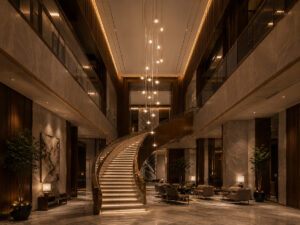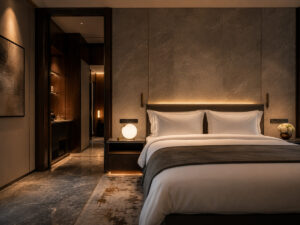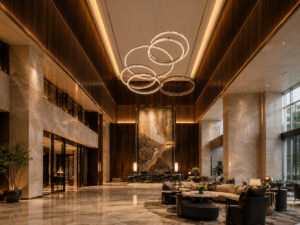
Guests forget the size of the lobby surprisingly quickly. They forget the artwork in the corridor. What they remember — what shows up in the review, in the rebooking decision, in the casual recommendation to a friend — is almost always how well they slept, and how the room felt when they were alone in it.
That makes the guest room the highest-stakes space in any hotel lighting project, and yet it’s often the one treated with the least technical rigor. This guide breaks down what professional hotel room lighting design actually involves — zone by zone, principle by principle — and draws on a recent five-star project completed by Guocio to show what the right approach looks like in practice.
This article is part of our broader guide on hotel lighting design, which covers the full property — facade, lobby, corridors, and public spaces. Here, we go deeper into the one space every guest actually lives in.
What Is Hotel Room Lighting Design?
Hotel room lighting design is the discipline of planning every light source inside a guest room — not as a single decision, but as a system of independent zones, each serving a different moment in a guest’s stay. It covers the entry and closet area, the bed and headboard, the desk or workspace, the seating or reading area, and the bathroom.
The priorities here are different from public hotel spaces. In a lobby, light can be dramatic, even theatrical. In a guest room, the goal is almost the opposite: light that feels personal, that responds to what the individual guest wants in that moment, and that recedes quietly into the background once it’s done its job. A guest room is not a stage. It’s a space someone has to feel comfortable enough to fall asleep in.
The 5 Zones of a Hotel Room
Every well-designed hotel room can be broken down into five lighting zones, each with its own function and its own technical requirements.
| Zone | Lighting Task | Key Consideration |
|---|---|---|
| Entry & Closet | Guide the guest in; make clothing and luggage clearly visible | Avoid harsh shadows inside closets; motion-activated options work well here |
| Bed & Headboard | Support reading and rest; signal wind-down | Independent dimmable lamps on each side, warm color temperature |
| Desk / Workspace | Support business travelers and laptop use | Glare-free task lighting, positioned to avoid screen reflection |
| Seating / Reading Area | Create a second, private pool of light away from the bed | Floor or table lamp at reading height, independently controlled |
| Bathroom & Vanity | Support grooming and self-care with flattering, even light | High CRI (95+), shadow-free mirror illumination |
The Principles That Make Hotel Bedroom Lighting Work
1. Warm Color Temperature, Always
3000K is the baseline for hotel bedroom lighting design in any five-star property, with some choosing 2700K for an even softer effect. Cooler tones — anything above 3500K — read as clinical and alert, which is the opposite of what a bedroom should communicate. Color temperature consistency across all fixtures in the room also matters: a bedside lamp at 3000K next to a ceiling fixture at 4000K creates a visibly disjointed, lower-quality feel. For the sleep science behind this principle, see our deep dive into hotel bedroom lighting design.
2. Guest Control Over Designer Intention
A beautifully designed lighting scheme that the guest cannot adjust is, functionally, a poorly designed one. Every zone in the room should be independently switchable and ideally dimmable — bedside lamps separate from the desk light, separate from the bathroom, separate from any ambient ceiling layer. The designer’s job is to make every one of those combinations look intentional, not to dictate a single fixed scene.
3. Low Glare, High Comfort
Bedside lamps positioned too high, too bright, or angled directly at eye level are one of the most common — and most easily avoidable — mistakes in hotel room lighting. Fixtures should be positioned at a height that illuminates a book or a phone screen without ever being visible as a direct light source from a reclining position.
Common Mistakes in Hotel Room Lighting
1. Uniform Cool-White Lighting
Using the same 4000K+ fixtures throughout a guest room — often a carryover from office or retail lighting standards — strips a bedroom of any warmth or hospitality character.
2. Poorly Positioned Bedside Lamps
Lamps mounted too high create harsh downward shadows across the face; lamps too low fail to support reading comfortably. Getting this height right is a small detail with an outsized impact on guest comfort.
3. Low Color Rendering in the Bathroom
A bathroom mirror lit with poor CRI fixtures makes skin tones look uneven or grey — a detail guests notice immediately, especially when getting ready before an evening out.
4. No Independent Light Zones
Rooms with a single master switch controlling every fixture force an all-or-nothing choice on the guest, removing the sense of control that defines a genuinely comfortable stay.
5. Lighting Specified After the Interior Design Is Finalized
When lighting is treated as a finishing touch rather than part of the room’s core design, fixture positions are often compromised by ceiling plans or furniture layouts that were never built to accommodate them. Involving a lighting design partner early avoids this entirely.
Case Reference: A Five-Star Guest Room by Guocio
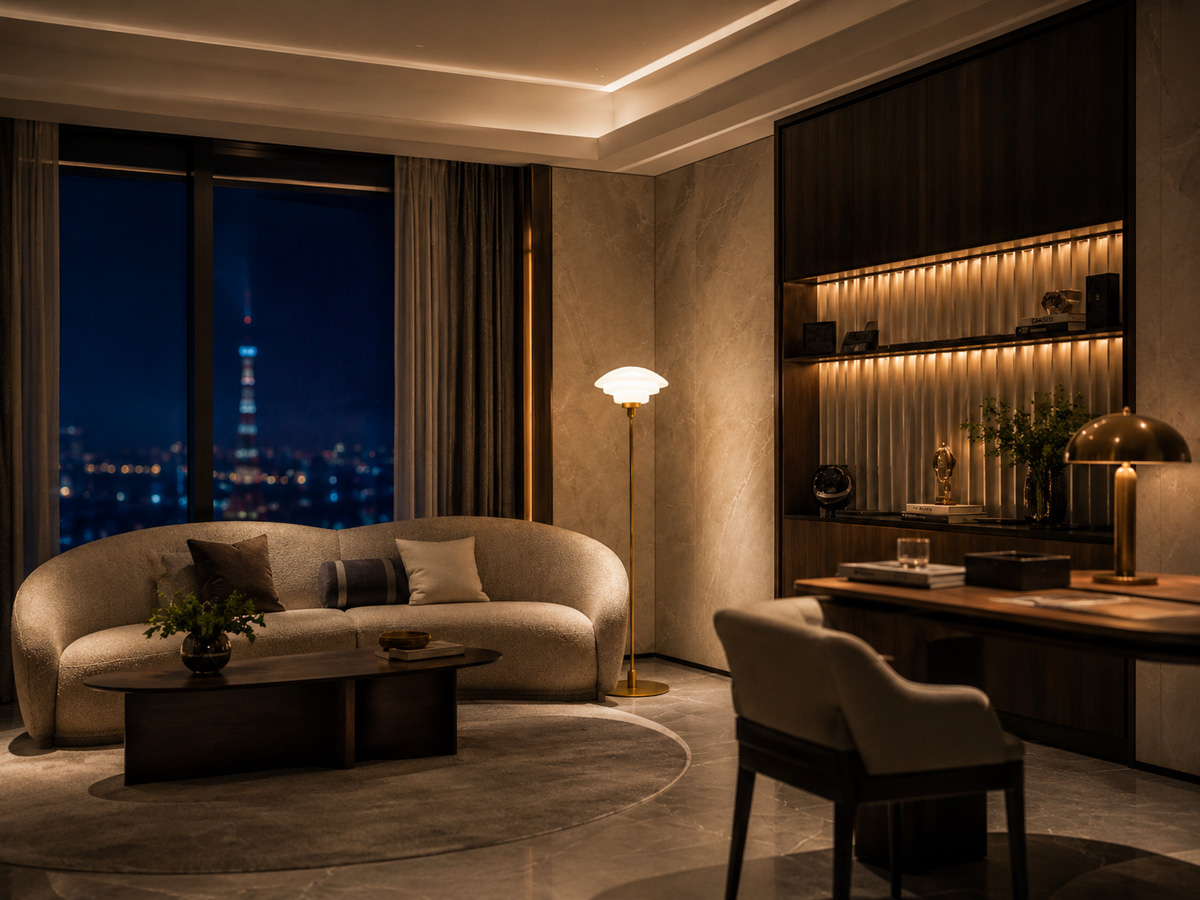
In a recent five-star hotel project, Guocio’s approach to the seating and reading area was built around giving guests a second, independent pool of light away from the bed. A Guocio floor lamp stands beside the lounge sofa, positioned to cast warm light at reading height without creating glare. When this lamp is on and the rest of the room is dim, the chair beside it becomes the most private, comfortable corner of the entire room — a small, considered act of hospitality rendered in light.
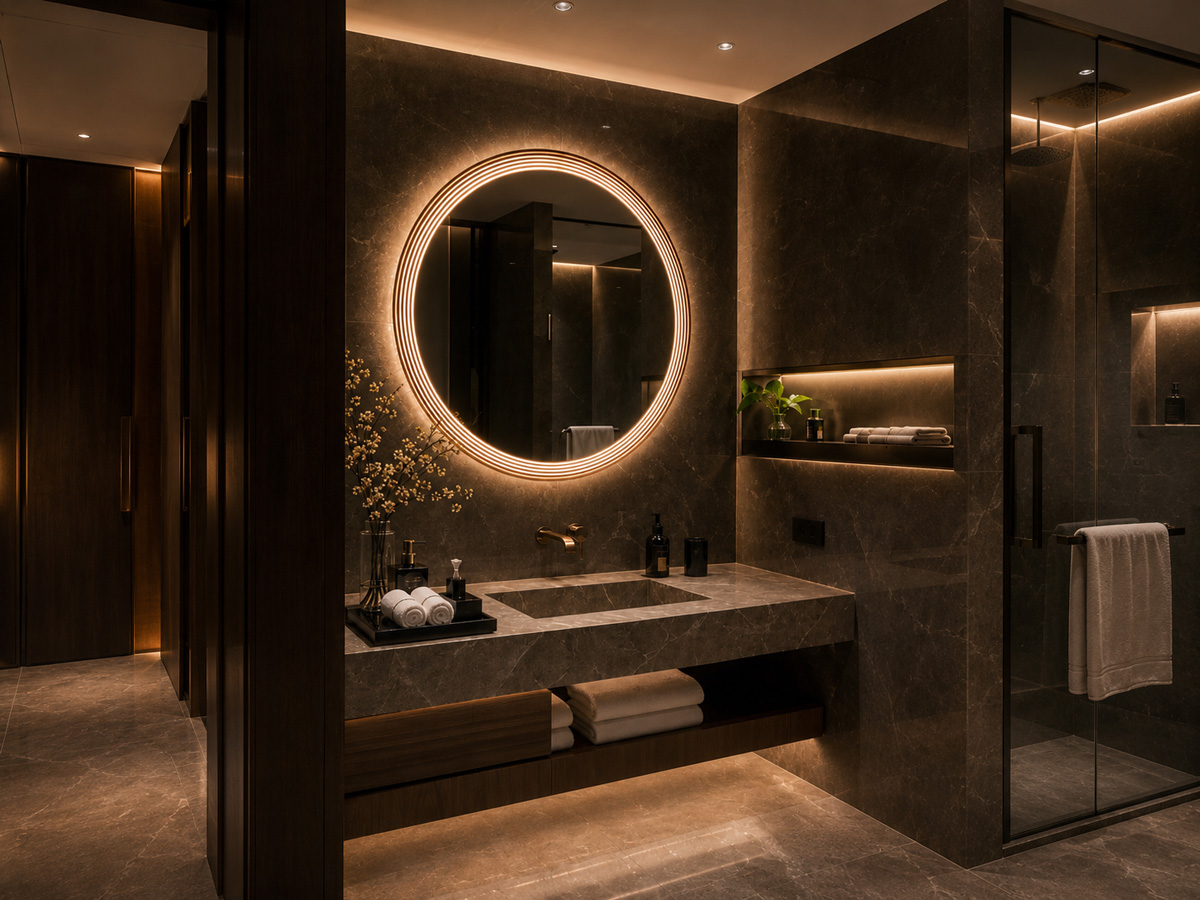
In the bathroom, a Guocio Halo illuminated mirror delivers CRI 95+ light that eliminates the shadows and color distortion typical of standard bathroom fixtures — turning a purely functional space into something closer to a spa experience. It’s a detail most guests won’t consciously name, but it’s often the one they remember most specifically.
See how this room connects to the rest of the property in the full case study, or read our complete guide to hotel lighting design for a property-wide perspective.
Frequently Asked Questions
What color temperature is best for a hotel bedroom?
3000K warm white is the standard for luxury hotel bedrooms, with some five-star properties opting for 2700K. This range is warm enough to support rest and lower cortisol in the evening, while remaining bright enough for reading and everyday tasks at the bedside.
Should hotel rooms have dimmable lighting?
Yes. Dimmable, independently controllable light sources are one of the clearest differences between an average hotel room and a five-star one. Guests should be able to adjust brightness at the bedside, the desk, and the seating area separately, rather than relying on a single all-or-nothing ceiling switch.
What is the best lighting for a hotel bathroom mirror?
A hotel bathroom mirror should be lit with high color rendering — CRI 95 or above — combined with soft, even, shadow-free illumination. This combination flatters skin tone and prevents the harsh, clinical look that poor bathroom lighting creates, supporting a spa-like guest experience.
How many light sources should a hotel room have?
A well-designed hotel room typically includes at least four distinct, independently controllable light sources: bedside lighting, desk or workspace lighting, seating or reading area lighting, and bathroom lighting, supported by a low-level ambient layer such as concealed ceiling coves or floor accents.
How does Guocio approach hotel room lighting projects?
Guocio designs hotel room lighting zone by zone — entry, bed, workspace, seating, and bathroom — specifying fixtures, color temperature, and control logic for each, then delivers complete technical documentation and on-site commissioning to ensure the finished room matches the design intent exactly. Get in touch to discuss your project.
Planning a Hotel Room Lighting Project?
Whether you’re designing a single guest room prototype or rolling out a lighting standard across an entire property, Guocio delivers complete lighting design services — from concept to on-site commissioning. For a property-wide view of our approach, see our full guide to hotel lighting design.