Ask guests what made or broke a hotel stay, and “how well I slept” almost always ranks near the top — above the breakfast, above the view, sometimes even above the price. And yet sleep quality is rarely treated as a design problem. It’s treated as luck, or as something the mattress alone is responsible for.
In reality, lighting plays a measurable role in how easily a guest falls asleep, how rested they feel the next morning, and how they remember the room. This article goes deep into that one specific relationship — light and sleep — within the hotel bedroom. For a broader breakdown of every lighting zone in a guest room, including the desk, seating area, and bathroom, see our companion guide to hotel room lighting design. Here, we’re focused entirely on the bed itself, and the light around it.
What Is Hotel Bedroom Lighting Design?
For the purposes of this guide, hotel bedroom lighting design refers specifically to the lighting that surrounds the sleep environment: the bedside lamps, any light integrated into or near the headboard, and the ambient ceiling layer directly above the bed. It does not cover the desk, entry, or bathroom — those zones are addressed in our full hotel room lighting design guide.
This narrower focus matters because the bed is where guests spend the most psychologically significant hours of their stay, and where lighting decisions have the most direct physiological impact. Getting the rest of the room right and getting this part wrong still results in a guest who didn’t sleep well.
The Science: How Light Affects Sleep
The relationship between light and sleep isn’t a design preference — it’s biology. The human body regulates its sleep-wake cycle, known as the circadian rhythm, partly through exposure to light. Specific photoreceptors in the eye are particularly sensitive to cooler, bluer wavelengths of light, and exposure to that kind of light in the evening suppresses the production of melatonin, the hormone that signals the body it’s time to sleep.
This is why a hotel bedroom lit with the same cool 4000K fixtures used in a corporate office can leave guests feeling subtly more alert and less ready for bed, even if they can’t quite identify why. Warmer light — in the 2700K to 3000K range — contains far less of that sleep-disrupting blue wavelength, allowing melatonin production to proceed closer to its natural pattern.
The same logic works in reverse for waking up. Some higher-end properties now incorporate gradual “sunrise simulation” lighting that slowly increases in brightness and shifts toward cooler tones over several minutes — a far gentler, more physiologically aligned wake-up than a sudden alarm or a single bright light switching on.
The Core Elements of Bedroom Lighting
| Element | Design Consideration |
|---|---|
| Bedside Lamps | Independent control on each side; touch-dimmable preferred over pull-cord or rotary switches |
| Headboard-Integrated Light | Built-in reading lights that avoid the visual clutter of standalone fixtures, while still allowing precise aim |
| Ambient Ceiling Layer | Indirect coves or perimeter lighting rather than direct downlights, which create glare when guests are lying down |
| Wake & Wind-Down Scenes | Pre-set lighting scenes — reading, sleep, and gradual wake — programmed into the room’s control system |
Principles for Getting It Right
Symmetry for Shared Rooms
When a room is designed for two guests, each side of the bed needs its own fully independent light source and control. One partner reading while the other sleeps is one of the most common real-world scenarios a bedroom lighting design has to support gracefully.
Glare-Free Positioning
The test is simple: lying flat in bed, a guest should never be able to see the bare light source of any fixture in the room. Bedside lamps should sit at a height that illuminates a book or phone screen without ever appearing as a bright point in the guest’s direct line of sight.
Color Temperature Consistency
Every fixture visible from the bed — bedside lamps, headboard lights, ambient coves — should share the same warm color temperature. Mixing a 3000K lamp with a 4000K ceiling fixture creates a visibly disjointed feel that undermines the calm the rest of the design is working to create.
Guest Autonomy
At minimum, a well-designed bedroom offers three independently controllable zones: bedside, ambient, and — where available — a wake-up scene. This gives the guest genuine control over their own sleep environment, rather than a single fixed designer-imposed mood.
Common Mistakes in Bedroom Lighting
1. Bedside Lamps That Are Too Bright
A lamp bright enough to read a restaurant menu by is too bright for a bedside table. Bedroom-specific fixtures should be specified at lower lumen output than general task lighting elsewhere in the room.
2. Poor Lamp Height
Too high, and the lamp casts harsh shadows across the face when reading. Too low, and it fails to provide usable light at all. The correct height is typically just above shoulder level when a guest is sitting upright against the headboard.
3. A Single Master Switch
Rooms where one switch controls every light in the bedroom force guests into an all-or-nothing choice, eliminating the kind of fine control that supports a genuine wind-down routine.
4. Direct Overhead Downlights Above the Bed
Recessed downlights positioned directly above the bed, without any diffusion or angling, create uncomfortable glare for anyone lying down — precisely the wrong effect in the one room where comfort matters most.
5. No Wake-Up Consideration
Most hotel rooms only think about how a guest falls asleep, not how they wake up. A jarring transition from total darkness to full brightness, with no graduated option, ignores half of the sleep cycle entirely.
Case Reference: A Sleep-First Bedroom by Guocio
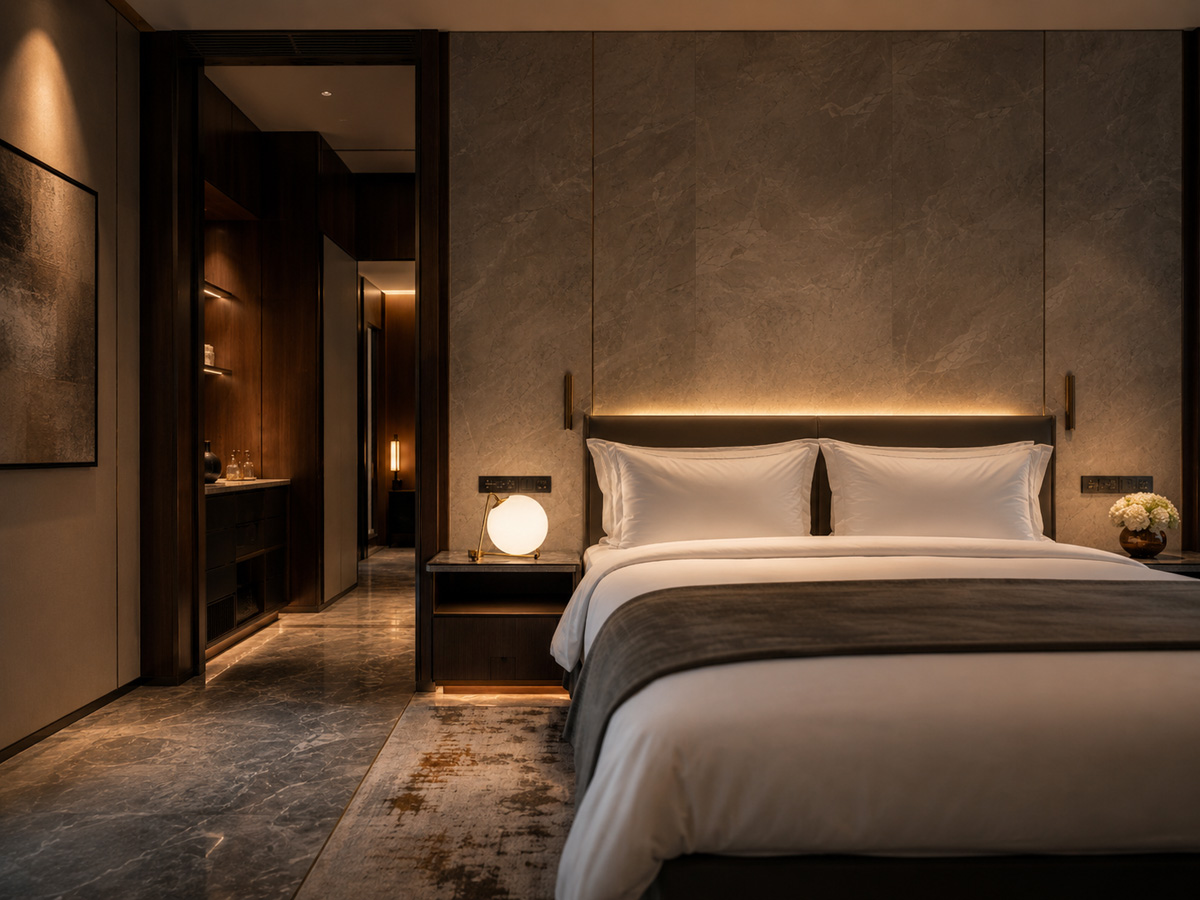
In a recent five-star hotel project, Guocio specified a Guocio Amber table lamp on each side of the bed, calibrated to 3000K and independently dimmable. The broader room lighting — concealed ceiling coves and low-level accents — was designed to recede almost entirely once the bedside lamps were switched on, narrowing the guest’s world down to exactly what they needed at that moment: the bed, the light, and nothing else demanding attention.
See the full property in the complete case study, or explore every lighting zone in a guest room in our guide to hotel room lighting design.
Frequently Asked Questions
What color temperature helps guests sleep better in a hotel room?
Warm color temperatures between 2700K and 3000K are best for hotel bedroom lighting in the evening. These warmer tones do not suppress melatonin production the way cooler, bluer light does, making it easier for guests to wind down and fall asleep naturally.
Should hotel bedside lamps have touch or traditional switches?
Touch-dimmable switches are generally preferred in luxury hotel bedrooms. They allow guests to adjust brightness gradually without fumbling for a pull cord or rotary switch in the dark, and they support the kind of gentle, gradual dimming that suits a wind-down routine.
What is circadian lighting and does it matter for hotels?
Circadian lighting refers to lighting designed to support the body’s natural 24-hour rhythm — typically cooler and brighter in the morning, warmer and dimmer in the evening. For hotels, this matters significantly, particularly for guests dealing with jet lag, since well-designed evening lighting can meaningfully improve sleep quality and guest satisfaction.
How should bedside lamps be positioned to avoid glare?
Bedside lamps should be positioned so the light source itself is not visible from a reclining position — typically at or just below shoulder height when seated up in bed, with a shade that directs light downward and outward rather than directly toward the eyes.
How does Guocio design hotel bedroom lighting for better sleep?
Guocio designs hotel bedroom lighting around the principle that light should support rest rather than compete with it — specifying warm, independently dimmable bedside lamps, glare-free positioning, and concealed ambient lighting that recedes naturally as the evening progresses, then delivers full technical documentation and on-site commissioning. Get in touch to discuss your project.
Planning a Hotel Room Lighting Project?
Whether you’re refining a single guest room prototype or rethinking your sleep environment standard across a whole property, Guocio delivers complete lighting design services — from concept to on-site commissioning. For the full guest room picture, see our guide to hotel room lighting design.