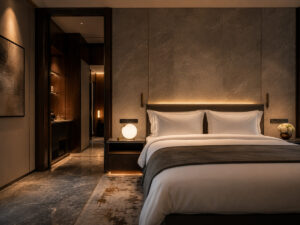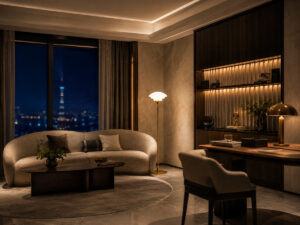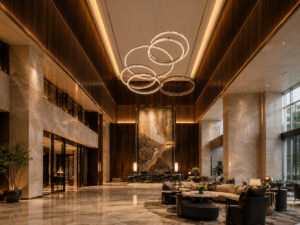
A guest forms their first real impression of a hotel within seconds of stepping into the lobby — well before anyone says hello, well before a single bag is carried. In that window, almost everything they register is shaped by light: how the room reveals itself, where their eye is drawn, whether the space feels generous or merely large.
This is what makes hotel lobby lighting design one of the highest-stakes pieces of any hospitality project. It’s covered briefly as part of our complete hotel lighting design guide, but the lobby deserves a closer look on its own — because it’s rarely just one decision. It’s a sequence.
What Makes Lobby Lighting Different?
A hotel lobby is asked to do something most commercial spaces are not: deliver a sense of arrival, provide a comfortable place to wait, and function as a quiet stage for social display, often all within the same few hundred square meters. That combination changes the lighting brief entirely.
Compare it to the guest room, where the goal is almost the opposite. Bedroom lighting works to recede, to feel private and calm. Lobby lighting is permitted — even expected — to be a little theatrical. It has an audience, and for the first few minutes of any stay, that audience is paying close attention.
The Anatomy of a Hotel Lobby: 4 Functional Zones
Every well-designed lobby can be broken into four distinct lighting zones, each with a different job to do.
| Zone | Lighting Task |
|---|---|
| Arrival & Threshold | Ease the transition in brightness from outdoors to indoors, avoiding visual shock |
| The Centerpiece | Anchor the room visually — usually a chandelier or sculptural fixture defining the space’s character |
| Reception Counter | Create a focused, human-scaled pool of light for the welcome interaction |
| Lounge & Seating | Lower, warmer ambient light that invites guests to stay rather than simply pass through |
The Centerpiece Question: Why the Chandelier Matters Most
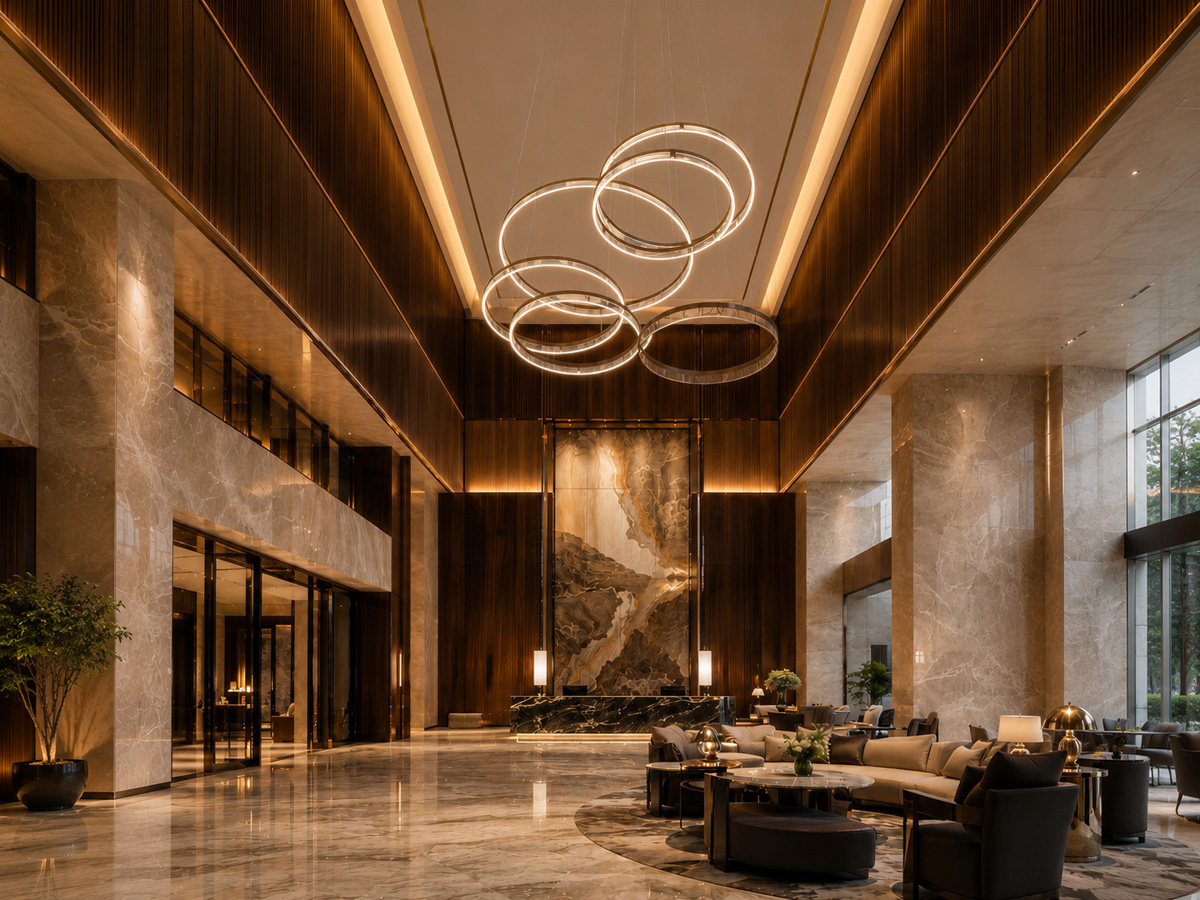
In a double or triple-height lobby, nothing shapes a guest’s perception of the hotel faster than the centerpiece fixture above them. A hotel lobby chandelier scaled correctly to the architecture becomes an instant, wordless statement about the level of the property — and a fixture that is too small, or too generic, undermines every other design decision in the room around it.
The chandelier shown here is a large ring-form composition, built from multiple combined elements rather than a single fixture — a deliberate choice that lets the piece read as architectural rather than decorative. It is sized to command the full vertical volume of the atrium, so that guests orient themselves around it the moment they walk in.
Choosing the right lobby chandelier is its own discipline, with its own technical and aesthetic considerations — one we’ll explore in a dedicated guide soon. For now, the principle that matters most: the centerpiece sets the ceiling, quite literally, for how impressive the rest of the lobby is allowed to feel.
Layering Light Around the Centerpiece
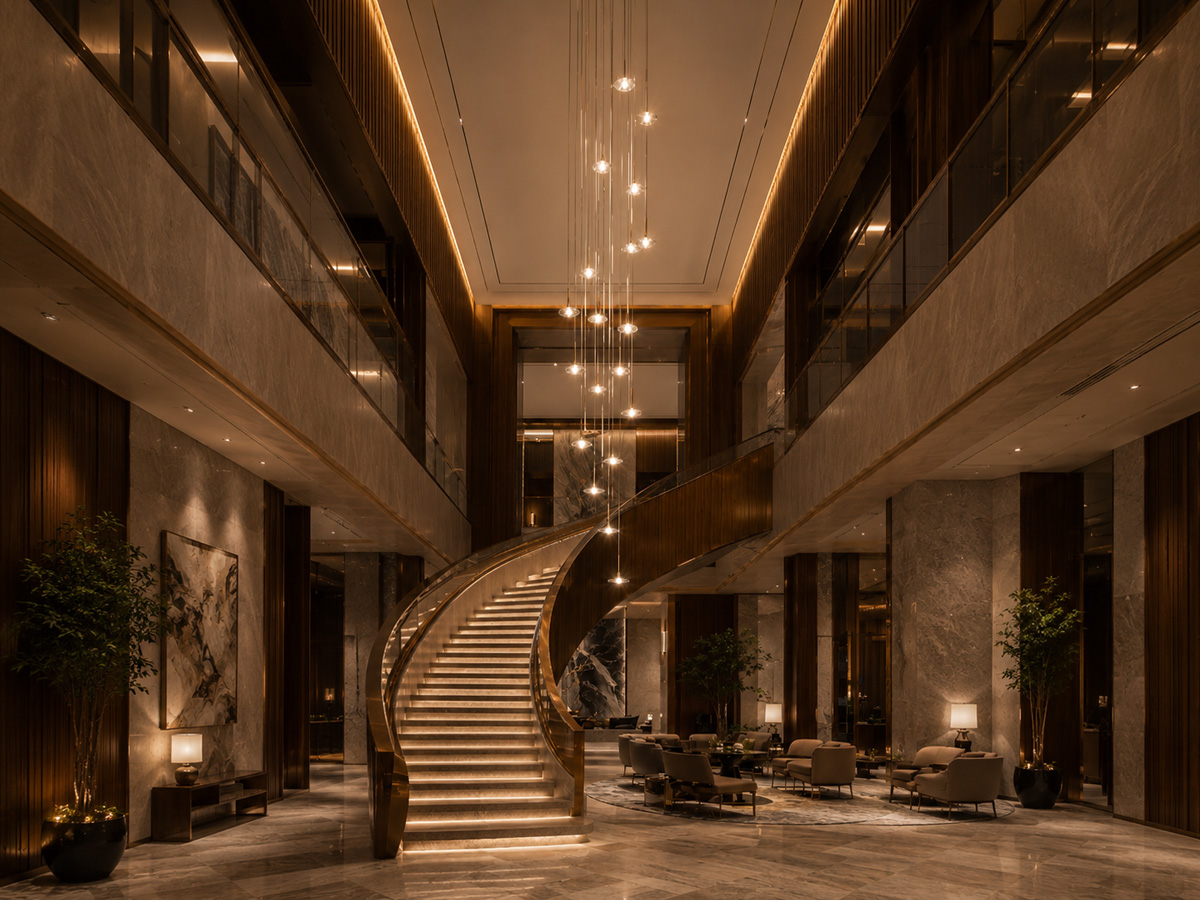
A great lobby centerpiece rarely works in isolation. In this project, the design language of the main lobby chandelier continues into the adjoining atrium, where a cluster of pendant fixtures cascades through the hollow stairwell void connecting multiple floors. The effect is continuity — guests moving between levels stay within the same considered lighting story rather than crossing into a noticeably different space.
This is the layering principle at work on an architectural scale: a primary centerpiece establishes the room’s character, a secondary feature extends that character through connected spaces, and everything else — recessed downlights, soft ceiling coves, low accent strips — recedes intentionally into the background. None of these supporting layers compete with the chandelier or the pendant cluster. Their entire job is to make sure nothing distracts from them.
This restraint is what separates a lobby that feels genuinely considered from one that simply has an expensive light fixture in it. Every secondary source is deliberately dimmer, warmer, and quieter than the centerpiece — supporting the room’s mood without ever competing for the eye.
Common Lobby Lighting Mistakes
1. An Undersized Centerpiece
A chandelier or pendant feature that is too small for its architectural volume leaves a double-height lobby feeling oddly empty, no matter how well everything else is designed.
2. Ambient Light That Competes With the Centerpiece
When the surrounding ceiling and wall lighting is too bright, it dilutes the visual impact of the feature fixture, flattening what should be the room’s most dramatic moment.
3. Cold or Clinical Reception Lighting
A reception desk lit with the same cool, even light as a retail counter undermines the warmth that should define a guest’s first direct interaction with hotel staff.
4. No Distinction Between Circulation and Seating
Lounge and waiting areas lit at the same intensity as walkways fail to signal “stay here” versus “pass through,” reducing the lobby’s ability to function as a comfortable social space.
5. Inconsistent Color Temperature With the Rest of the Hotel
A lobby lit noticeably cooler or warmer than the guest rooms and corridors creates a jarring shift in atmosphere as guests move through the property — undermining the kind of property-wide consistency discussed in our full hotel lighting design guide.
Case Reference: A Grand Lobby by Guocio
Both fixtures shown above are part of a single recent project: a contemporary luxury five-star hotel, where Guocio delivered the complete lighting design across the property — including a bespoke ring-form lobby chandelier and a coordinated cascading pendant installation through the adjoining atrium staircase. The lobby’s double-height ceiling, marble flooring, and 3000K warm white color temperature were all factored into the scale and placement of every fixture.
| Project Type | International Five-Star Hotel |
| Lobby Centerpiece | Bespoke Ring-Form Combination Chandelier |
| Adjoining Space | Cascading Pendant Cluster, Atrium Staircase |
| Color Temperature | 3000K Warm White |
See how the lobby connects to every other space in the property in the full case study →
Frequently Asked Questions
How should lighting change between a hotel’s entrance and its lobby?
Lighting should transition gradually rather than abruptly. A sudden jump in brightness or color temperature between the entrance and the lobby creates visual discomfort and breaks the sense of arrival. The best hotel lobby lighting design uses a graduated approach, easing guests from exterior light levels into the interior atmosphere over the first few meters of the space.
What makes a hotel lobby chandelier different from a residential one?
A hotel lobby chandelier must be scaled to the full architectural volume of the space, often spanning a double or triple-height atrium, while meeting commercial durability standards, safe maintenance access, and compatibility with professional dimming and building control systems. Residential chandeliers are designed for intimate rooms; a lobby chandelier functions closer to architectural sculpture.
How bright should hotel lobby ambient lighting be?
Lobby ambient lighting should generally sit at a lower intensity than the lobby’s centerpiece fixture, providing a calm, supportive backdrop rather than competing for attention. The goal is a layered effect where the eye is drawn naturally to the feature lighting, while the surrounding space remains comfortably and evenly lit.
Should reception desk lighting differ from the rest of the lobby?
Yes. Hotel reception lighting typically uses a more focused, human-scaled light source — such as a table lamp or pendant directly above the counter — to create a warm, intimate zone for the brief but important interaction between guest and staff, distinct from the broader ambient lighting of the lobby.
How does Guocio approach hotel lobby lighting design?
Guocio designs hotel lobbies as a sequence of connected lighting moments — arrival, centerpiece, reception, and seating — ensuring each zone supports the others rather than competing for attention, then delivers complete fixture specification, bespoke manufacturing where required, and on-site commissioning. Get in touch to discuss your project.
Planning a Hotel Lobby Lighting Project?
Whether you’re designing a single feature chandelier or coordinating lighting across an entire arrival sequence, Guocio delivers complete lighting design services — from concept to on-site commissioning, with full bespoke fixture manufacturing capability. For a property-wide perspective, see our complete guide to hotel lighting design.